Sunday, July 7, 2019

Social Media and our Failures

Jonathan Haidt speaking in Seattle
Earlier this year, Jonathan Haidt came to Seattle and spoke about the rise in polarization that he and others have noted since around 2013. What has changed? he asked us to wonder. His answer is social media. As the 2016 election taught us, social media are fertile ground for lies, half-truths, and outrage. Outrage generates clicks, and now even newspapers play the outrage game so that their online articles can get the clicks, too. Haidt’s comments got me to think some more about the lamentable failure of leftist movements over the past several years. It seems as though, just when the calls for change have gotten loudest, we have failed the hardest. Let’s review what’s going wrong, and right, over the last several years.

Successes pre-2013
One reason I love being a lefty is that we just win and win and win. Look at the last 100 years, and our forward-thinking reforms have been vindicated over and over. Consider women’s suffrage, defendants’ rights, Social Security, minority rights, Civil Rights, reproductive freedom, affirmative action, gay rights, disability rights, and more. In the ten years before 2013, we were still doing well. We landed a black man in the White House, something that would have been impossible earlier in my own lifetime. We expanded health insurance coverage. The gay-marriage campaign swept the nation with its appeal to love and fairness. The Obama administration got the abortion pill, RU 486, tested and approved. We even got our black president re-elected when pundits said that the unemployment rate was too high for any incumbent president to win. Yes, there was conservative resistance to all this progress, but that’s been the case for as long as we progressives have made progress. But then what happened? 

Zimmerman verdict
In 2013, outraged citizens on social media demanded that George Zimmerman be tried for the shooting of Trayvon Martin. The governor of Florida dutifully overrode the local authorities to have Zimmerman put on trial, and the prosecution lost. Zimmerman should have listened to the 911 dispatcher who told him to stay put and not go follow the stranger he saw walking through his neighborhood. Being a belligerent shithead, however, is not a crime, and the facts of the case did not support the charges that the state brought against him. After the fact, plenty of people have said that the prosecutor should have charged Zimmerman with a lesser crime that could have stuck, but it’s easy to imagine how much pressure the newly installed authorities were under to throw the book at him. Like many other left-leaning Americans, I thought that a guilty verdict was all but assured, and the loss came as a blow to morale.  

#BlackLivesMatter
I wish this movement had been half as effective as it was popular. It achieved a high profile but few results. How can a phrase like “black lives matter” fail? Of course black lives matter. Racial disparities are an ongoing problem in the States, so serious that the entire nation is dragged down by the problems that plague the black community. The US Army has managed to integrate its officer corps, creating perhaps the best integrated managerial body anywhere in the world, but their success hasn’t been replicated anywhere else in the nation. The increase in economic inequality that we’ve seen since the 80s has naturally hit the black population harder than it’s hit whites. With all that background, here was a movement that had real potential.

The BLM movement succeeded in the first steps toward progress. It raised the profile of the fraught relationship between the black population and the police, and it helped expose predatory policing practices, such as those in Ferguson. It offered a ten-point plan to reform policing across the nation. BLM representatives got all the way to the Oval Office to meet with President Obama.

Once they got the attention of the nation and the president, what did BLM activists achieve? In terms of concrete progress, there hasn’t been much to show. The use of the #blacklivesmatter hashtag dropped off on in the summer of 2016, possibly in response to the killing of five police officers in Dallas and then three more in Baton Rouge.

In 2016, Black Lives Matter activist Shaun King announced a nationwide Injustice Boycott, meant to punish cities, such as New York City, accused of state violence toward the black population. It seems to have gone nowhere. 

2016 election
The left’s approach to the presidential election of 2016 was more about being outraged at Trump than at promoting Hillary. Unlike Bernie, Hillary was a centrist Democrat who seemed to represent the status quo. I like the status quo because for a hundred years the status quo has generally meant liberal progress, but 2016 wasn’t a year for the status quo. Especially on social media, leftists wanted a cause more emotionally driven than Hillary’s practical, realistic approach to progress. Looking for emotions, the left dumped vitriol on Trump, all of which he deserved. What was the net result? He won. The vitriol kept his brand name alive, and it proved to his supporters that he was the man who could really stick his finger in the eye of us leftists. At the last minute, seeing that Trump had a real chance to win, game professional friends and I ginned up a pro-Hillary stunt, but efforts like ours were too little too late.

Hillary handily won the popular vote. She earned more votes than any white man in the history of the US, but it wasn’t enough. Trump is roundly and rightly considered unfit for the presidency, morally bankrupt, and just plain crooked. The left, however, couldn’t rally itself enough even to keep this monster out of the White House. We’ll be paying for this loss for years, probably decades. The loss was deeply demoralizing to the left, myself and my daughter included.

After the election, the nation learned the Russia had spread division and disinformation on social media. Remember, our enemy wants us to be outraged and divided, and they found social media to be useful in achieving that goal. 

#NoDAPL
In the fall of 2016, leftists found an appealing cause in protecting sacred Native American land from a planned oil pipeline. The #blacklivesmatter hashtag had dropped in popularity that summer, and Hillary’s campaign for president didn’t inspire people. Filling the void was #NoDAPL. Opposition to the pipeline had begun in the spring and had grown in the summer, peaking in the fall. It’s hard to imagine a social-justice confrontation that could be more appealing to leftist ideals. On one side was the filthy petrochemical industry, and on the other were Native Americans protecting the integrity of their sacred lands and the purity of their water. Support poured in from across the nation and the world, inspiring left-leaning people everywhere. In December, following President Obama’s intent, the Corps of Engineers denied an easement to the pipeline so that it couldn’t pass under the Missouri River. The activists joyously declared victory, and I breathed a sigh of relief.

Then Trump took office, and soon enough the situation reversed. Dispirited activists largely abandoned Standing Rock, and soon enough the encampment was cleared away and oil started flowing through the pipeline. Again, this loss was a hard blow to the morale of the left. A local professional activist who had spent time at Standing Rock recounted how, after the loss, he had to take a long break from activism to recover his mental health. Today you might hear leftists saying that the protests at Standing Rock were a victory because it launched a movement, but that’s not the victory that protestors had their hearts set on.

#MeToo
In the fall of 2017, actress Alyssa Milano publicly accused Harvey Weinstein of sexual-predator behavior and encouraged the use of the #MeToo hashtag. It took off, leading to greater awareness of sexual harassment in general and to damning accusations leveled at many well-known men. Of the many social-media-powered movements of the last several years, this one seems the most successful. Why did it succeed where other movements failed? If we could figure that out, maybe we could find ways to make other online movements successful, too.

Perhaps the peak of the #MeToo movement came in 2018 with the nomination of Brett Kavanaugh to the Supreme Court, although this was the peak of its salience on the national stage, not a success. For a while it looked as though the pressure against Kavanaugh would win out. His accuser was competent and believable. Kavanaugh was angry and pathetic (“I like beer”?). Again, however, we on the left suffered a demoralizing loss.  

2018 midterm elections
One concrete success that we on the left have enjoyed recently is our strong showing in the 2018 midterms. Thank god. Democrats gained governorships and took control of the House of Representatives. The Republicans made gains in the Senate, but not because they got more votes. Most of those Senate races came six years after the Democrats had an unusually strong showing in the Senate, riding along President Obama’s re-election victory. It’s natural that some of the seats gained in 2012 would shift back to the Republicans in 2018. Dems won most of the contested Senate seats; they just didn’t win enough seats to hold onto their big advantage from six years earlier.

Our electoral victory was not powered by social media. There were no national elections, which are especially attractive to social media campaigns. Trump wasn’t running, so he didn’t lure activists into piling on him the way he did in the presidential election two years earlier. If the midterms had gone against the Dems, I would have been strongly tempted to give up hope. 

Shame mobs
One thing social media have been good at is targeting individuals, although even these successes have uncertain results. One famous case was that of Tim Hunt, a British biochemist, molecular physiologist, and Nobel laureate. In 2015 during a talk about women in STEM, he made ironic comments in a tone of voice that indicated he wasn’t serious. These comments were transcribed and shared around the Internet, lacking tone of voice, and there was an international outcry. A concerned, liberal friend of mine said that Hunt’s comments were damaging because they dissuaded women from entering STEM fields. I totally agree. Those comments, shared around the world, gave women the impression that many experts would not welcome them in STEM fields. But how much damage would those comments have done if they hadn’t been taken out of context and hadn’t been disseminated on social media? Was the net effect of the shame mob to make women more likely to choose STEM careers or less?

Or consider the case of James Damore’s Google memo of 2017. Yes, it offended people with its reference to inborn differences between men and women, but outraged people on social media exaggerated and misrepresented what Damore had said. By making his memo sound worse than it was, they made programming seem less attractive to young women. 

An analogous event took place here in Seattle in 2018, when controversy erupted over Stuart Reges’s article in Quillette about the gender gap in computer science and what we can do about it. Based on his years of experience teaching, he recommended making it mandatory for students to take a coding class, which would expose more female students to coding. That recommendation was ignored, and instead his critics shamed him for his comments about gender and academic achievement. In the article, he pointed to evidence that boys are more likely to do better in math than in reading, while girls are more likely to do better in reading than math. The Seattle Times reporter garbled this position into something different and false: that boys are better than girls at math. As a result, people got a false impression about Reges and, by extension, about how welcome women are in STEM fields. When shame mobs make things out to be worse than they are, they hurt the very people they are trying to help.

How to overcome outrage
If outrage on social media hurts our cause and plays into Russia’s hands, we should stop it. Currently there are groups working to overcome divisions, and we can join up with them. Jonathan Haidt and his crew have the OpenMind program for organizations that want to hold discussions that are productive instead of destructive. It features a self-study segment that is eye-opening even if you never use their templates for group discussions. Better Angels is trying to depolarize America with conversations. The group More in Common is also working to overcome polarization, with their Hidden Tribes program as their major contribution that effort. The left’s pattern of letting outrage guide us has failed repeatedly, and we need to do better.


Hidden Tribes from More in Common: https://hiddentribes.us

- - -

Calls to Liberal Action: Another post about how the left needs to do better.

Sunday, June 30, 2019

Being Wrong Sucks

What is it like to be wrong? 
Kathryn Schulz gave a famous TED Talk in which she points out that, for the most part, being wrong feels like being right. After all, people who are wrong feel like they are right. Even when our beliefs are false, they feel right to us. On the other hand, I was dead wrong about big things when I was a young man, and in retrospect I can see how being wrong shaped how I talked about the things that I was wrong about. Being wrong led me to approach my views narrowly and shallowly. 


Simple formulas
When I was a self-styled mystic, if someone questioned my spiritual beliefs, I could say that we were each on our own spiritual journey, so I wouldn’t expect them to agree with me. When I thought that no gender differences were inborn, if my brother reported that his infant son was notably more “boy-like” than his older sisters had been, I could explain any reported differences as caused by subconscious messaging and confirmation bias. When I thought nonhuman animals had no conscious inner experience, I could ascribe all the observed behavior in nonhuman animals to automatic reactions regulated by neural activity. These are all either-or propositions. “No spiritual journey is better than any other.” “No newborn is psychologically more boy-like or girl-like than any other.” “No nonhuman animal is more conscious or emotional than another.” Simple formulations like these defy investigation and are therefore good ways to prevent false ideas from being revealed as false.

Creationists love simple takes on science, such as the idea that evolution contradicts the law of entropy. Atheists who deny the historical Jesus like to say that Jesus is simply like Zeus or Spider-Man, when obviously he’s a lot more like John the Baptist. Critical theorists* say everything is about power. 


Incuriosity
Even though, as a young man, I understood evolution, I still accepting the teaching that boys and girls are born with essentially identical psychological and behavioral predispositions. I never showed any interest in speculating about how the sex-differentiated instincts of our ancestors might have “evolved away”. I never tried looking up scientists who would have contradicted what was in my fraudulent textbook, which featured the infamous case of David Reimer. As a spiritual seeker, I never worked too hard at figuring out the truth. Star Wars had taught me to just “trust”, with no training or discipline needed. I read spiritual books, but as a hobbyist, not as a devotee. If nonhuman animals were unconscious because language created inner experience, then why wasn’t I curious about what happened with Helen Keller? Did she suddenly becoming self-aware when she learned sign language? Why wasn’t I curious about how language and self-awareness develop in children?

Creationists are not curious about which animals group together to form “kinds”. They don’t pursue archeological investigations to figure out which ruins are from before the Flood and which after. Atheists who say Jesus never existed are not curious about how Christianity started. Critical theorists don’t try measuring the relative power of groups over time, or comparing relative levels from one place to another. You’ll never see a graph of how the white-black power gap has risen or declined over the 20th century. 

Rigidity
When I thought that the government should provide everyone with a guaranteed income of $30K a year, I dismissed skepticism as backward and had no way to question whether my dollar figure was right. It was based on intuition, so there was no way to consider whether $20K or $40K might make more sense. (That $30K from 1987 would be over $60K in today’s dollars.) When I heard a case study of workers appreciating an incentive system that paid them more to work faster, I compartmentalized it so that it would not alter my impression that the getting workers to work faster was exploitation. 

Christians are obliged to talk about the Trinity in certain ways and must not talk about it in certain other ways. The three Persons must be distinct but coequal, and the metaphor of one God with three “masks” is forbidden. That’s true even though “person” originally meant “mask”, prosōpon in Greek. Jesus-denialists will talk about whether there’s proof Jesus existed but but don’t like talking about the most likely account of how early Christianity could have developed the weird way that it did. 


Anger and contempt
The flip side of these defenses was contempt toward people who disagreed with me and anger toward them if they had actual evidence that I couldn’t dismiss. The contempt was for people who were unenlightened, and the anger was for people who threatened my ideas. 

Go online and watch people disagree over politics, culture, or religion, and you know what you’ll find: contempt and anger. 


“What if I’m wrong?”
Twenty or thirty years after the fact, it’s easy to see how wrong I was. Partly that’s because it’s not painful to admit that one was wrong decades ago the way it is painful to admit that one was wrong earlier today. How likely is it that people can self-reflect and see the signs of error in their own current behavior? In my personal experience, it takes a lot of work to get there.

- - -

* “Critical theorists”: Critical theory is the ’30s–era political philosophy that describes oppression as power struggles between groups, driven by ideology. It is marked by the Marxist and Freudian theories of human nature that were popular at the time, and it’s become so common in social justice circles that most of the people who promote it just take it for granted. Most proponents seem not to know that their ideology has a name or even that it’s an ideology. If folks don’t like the term “critical theory” for this school of thought, I’m happy to call it whatever they like if that let’s us avoid debating semantics.


Sunday, May 12, 2019

Testosterone for Amateurs

Testosterone drives male
robins to compete
Testosterone is in the news these days. It’s an interesting hormone that gets talked about a lot, especially in terms of human differences. Speaking personally, I value testosterone as one of the things that connects our little human family to the wider family of animals. Here’s what I’ve learned about testosterone over the last 10 to 20 years.
Testosterone (T) is a steroid. It occurs in both men and women, but most men with “low testosterone” have levels that would be off the charts for women. In addition to levels being higher in adult males, they are higher in male fetuses, infants, and adolescents. 
In vertebrates at least, testosterone mediates the development of a masculine phenotype, with “masculinity” meaning different things for different species. The hormone that drives a male robin to face off with other males is testosterone. In the winter, when T levels are low, male robins tolerate each others’ presence rather than fighting. For most mammals, T spurs growth and thus males are larger. For species of lizards in which males are smaller than females, T inhibits growth instead.
The default body plan for mammals is female, with male hormones diverting the embryo toward the male phenotype. An XY mammal that is insensitive to T develops as an infertile female.
In almost all mammal species, testosterone makes males bigger and stronger, on average, than females. That’s true for humans, and men’s upper body strength points to an evolutionary history of physical struggle. The dimorphism in our species, however, is small relative to other apes and nothing compared to gorillas or sea lions. Men don’t have antlers or peacock tails or other outlandish adaptations for out-competing the other males. Our species’ modest level of dimorphism suggests that male-to-male competition over mates has been low, lower than among chimpanzees or orangutans.
Testosterone levels have a large effect on human development and a smaller effect on current behavior. Exposure to T in the womb organizes the brain along male lines, especially with connections that become active when exposed to T at adolescence. In mammals, brains are wired for both male and female behaviors, with males predisposed toward but not limited to male-typical behaviors, and the same with females and female-typical behavior. 
Prenatal exposure to T predisposes a child to rough-and-tumble play and probably to being sexually attracted to women. 
Boys tend to be born larger than girls, especially a woman’s first son. Hormones at puberty increase the dimorphism between the typical males and females.
T promotes the sex drive in men and women. 
Trans men who take testosterone often report changes to mood. 
Each human is individually more or less sensitive to testosterone depending on the length of the “CAG repeats” associated with their androgen receptor genes. The gene is on the X chromosome, so women have two copies and are thus more likely to be in the “average” range of sensitivity. 

Further Reading

The Red Queen: Sex and the Evolution of Human Nature by Matt Ridley. If you want to learn about how sex functions and evolves not just for humans but across the family of living things: bacteria, parasites, millipedes, etc. 

The Female Brain and The Male Brain by Louann Brizendine. If you want to learn how hormones affect individual development and the human experience from embryogenesis to senescence. 


Sunday, April 14, 2019

2019

Untrue and Female Sex Instincts

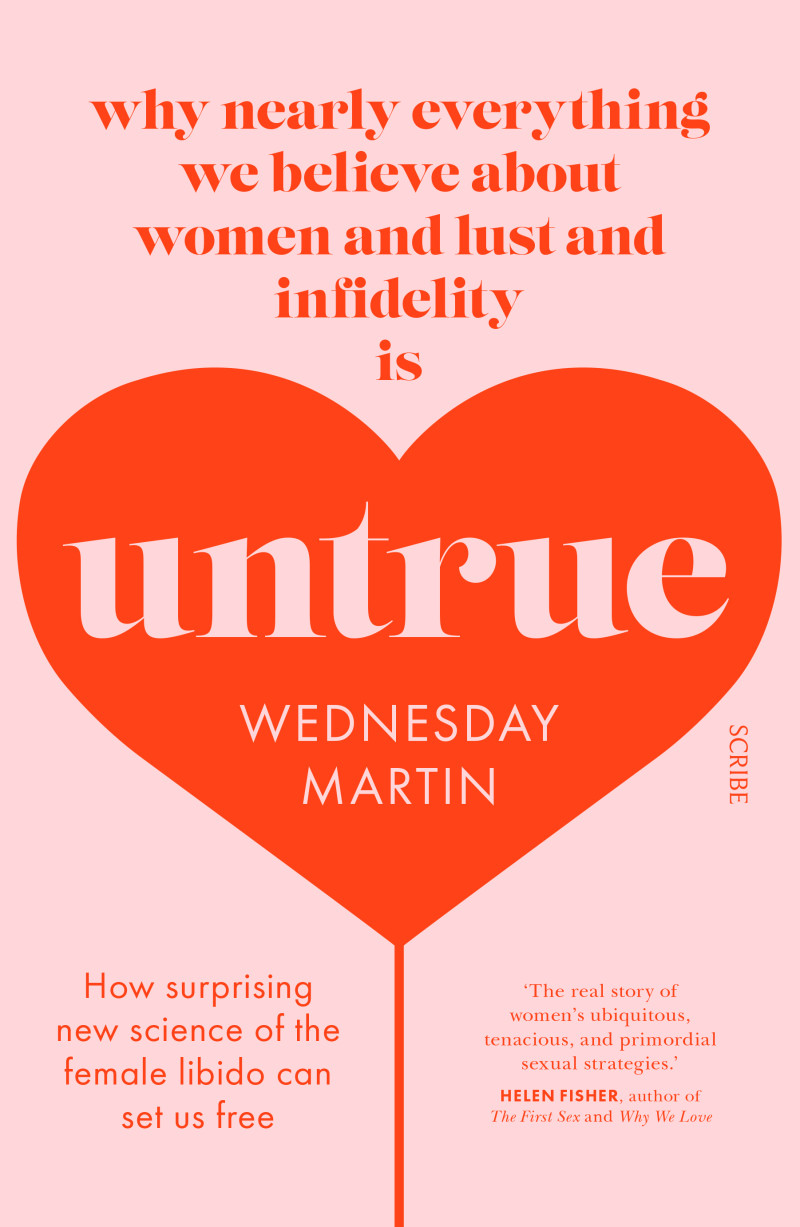
An anthropologist suggested that I read the book Untrue by Wednesday Martin for an example of a good treatment of modern thinking on evolved behavior, and I’m glad she did. The book has some great takes on sex instincts, particularly those involved in female “extra-pair coupling”, as the biologists call it. It’s not the first book I would recommend on evolution and sexuality, but I got a lot out of it.

Men of faith and men of science have long described women’s sexuality in limited terms, and Martin shows how wrong these simplistic views are. In civilizations east and west, men have defined a wife’s infidelity as a sin or a biological aberration. Martin demonstrates that extra-pair coupling is indeed part of the human female’s sexual repertoire. While women have been relentlessly programmed to be submissive and faithful wives, Martin shows that women have sex drives that send many wives seeking partners other than their husbands. The brain evolved for behavioral flexibility, and human behavior is facultative. That is, we have more behavioral routines that we ever use, and we use the ones that fit any given situation. Studying psychology in the 1980s, I was taught that society conditioned people so that socially constructed behavior patterns, such as gender roles, seemed natural. Untrue shows just how limited any such conditioning is, as women’s instinctive drives lead many of them to break the rules they were supposedly conditioned to internalize.

Western civilization, notes Martin, has tried to define women’s sexuality as passive, the supposed counterpart to the active male. But this passive role doesn’t stick, and in real life women are not passive but responsive. That’s a great clarification. Speaking personally, I prefer “responsive” to “passive”. 

Biologists talk about “female choice”. Among mammals in particular, females invest so much of their own lives and energy in their young that they can be choosy about which males impregnate them and thereby get a “free ride” on all their blood, sweat, and milk. In historical civilizations, however, families have exercised oppressive control over their daughters’ choices. Female choice is on full display when Martin discusses Ashley Madison, the web site for wives who wanted to cheat. The women on that site were able to specify, sometimes down to penis size, the sorts of lovers they would consider taking.

In evolutionary terms, it pays off for a female mammal to mate with a high-status male, since doing so increases the odds that one’s sons will achieve high status. That behavior is called called hypergamy, and in human society it commonly appears as women “marrying up”. In fairy tales, the commoner girl marries the prince. Martin provides us with great example of hyergamy with the housewives of the 50s and 60s who carried on affairs with their husbands’ superiors. Eventually, the women left their lower-status husbands in favor of their new, higher-status mates. So much for being programmed to passivity.

For the readers who might think that gender roles can be constructed any which way without regard to universal human predispositions, Martin cites anthropologist Agustin Fuentes as saying that there are indeed half a dozen instances of gender-role differences that are universal among humans.

Untrue has a lot more details, such as the author’s visit to a “skirt party” for adventurous women, but my take-away is the power of primeval instincts in the face of modern attempts at socialization.

Sex at Dawn, by Christopher Ryan and Cacilda Jethá: Untrue shows that sexual instincts make themselves felt in today’s society, and Sex at Dawn covers a more explicitly evolutionary take on the topic. Martin mentions this book, and I’ve recommended it before, but I hear that science people aren’t impressed with it, so haven’t been recommending it lately.

The Red Queen, by Matt Ridley: This book is my top recommendation for the science of sex, including bacteria, millipedes, parasites, and more. I hoped it would be a good overview of humanity’s evolved sexuality, but it is way more than that. More people should read this book. 

Sunday, March 31, 2019

2019

Two timers, no waiting

Timing Group Discussions

Previously, I’ve posted about the problems I’ve seen during free-form discussions, specifically where some people talk more than they need to at the expense of others. When I teach my game-design class each fall, my rule is that students have to raise their hands and be called on. Without that rule, students with certain personality types would speak up more than their share. (The Y-chromosome seems to correlate with this behavior.) When I moderate panels at conventions, I give each member of the audience one chance to ask a question or make a comment before anyone speaks a second time. Otherwise, the quiet members of the audience are shut out while the talkative members get more than their share of attention. I’ve got a new trick that I’m using for a discussion of Jonathan Haidt’s The Righteous Mind: using one-minute hourglasses to give each participant a one-minute spotlight. We start the discussion with a round of one-minutes statements from each person, about a dozen of us.. Then we discuss things more less freely, after which we have a second round of one-minute comments near the end of the 90-minute session. There’s some time after the second round for discussion, but not much. The people in the book discussion group say they like the new system with the timers. 

The trick is to get two timers. We go around the circle and give each person a chance to speak. The first speaker turns over their one-minute hourglass, and when they’re done they hand the hourglass to the third speaker. If the hourglass hasn’t run out, the third speaker lets it run out while the second speaker talks. When the first speaker has finished, the second speaker turns over their hourglass, and when they’re done, they hand the hourglass to the fourth speaker, etc. You could use an electronic timer that restarts instantly, and then you wouldn’t need two, but where’s the fun in that?

I have seen single one-minute hourglasses used before, but they’re awkward when the previous speaker still has time left in their hourglass. I copied the two-hourglass system from a Unitarian meeting about climate justice. Having little props to fiddle with is fun. The timers may be a little dorky, but one thing I like about us Unitarians is that we’re not afraid to be a little dorky together. The Science Book Discussion group that’s reading The Righteous Mind is also through my Unitarian church. 

The one-minute timer is just one way to manage a conversation with a lot of different people and different personalities. My point isn’t that you should use my particular system. My point is that open-format discussions are systematically unfair and that everyone running a discussion needs ground rules or protocols of some sort to even things out better. 

PS: One-minute timers. If you’re in Seattle, you can get one-minute hourglasses at Top Ten Toys in Greenwood, like I did. It’s a neat store. 

Previous blog post. Talking Over Women: Misadventures in atheist meet-ups (October 2014). 


Sunday, February 24, 2019

Resources for Studying The Righteous Mind

The book I recommend the most. 
Jonathan Haidt’s book The Righteous Mind is the book I recommend the most. It has changed the way I understand political conflict. Irrational behavior that used to baffle me, such as denying evolution or thinking Saddam Hussein was behind 9/11, now makes perfect sense to me. Haidt shows how political and religious conflicts are grounded in evolved, moral feelings. These feelings provide us with moral judgments, for which we then invent justifications so plausible that we believe them ourselves. This analysis informs the moderated dialogs that a friend and I have been running in Seattle for years. Now at my Unitarian church, I’m running a book discussion group on The Righteous Mind, and I’ve collected links to a few good, online resources for anyone who wants to understand what Haidt is saying here. 

Bill Moyer and Jonathan Haidt
This is reportedly the best video to get an overview of the book and to see what Haidt looks and sounds like. 50 minutes, video. Link

Jonathan Haidt and the On Being Project
Good introduction, with extra emphasis on religion and Judaism. 50 minutes, audio. Link.

Figures and images
The figures and images from the book. You can pick up a lot just by reviewing them. Link.

YourMorals.Org research site
Learn about your moral feelings while helping researchers calibrate their tests. This site let me create a group just for people in my church, so we can each see how we compare to others in the church who took the same test. You can spend hours here. Link.

The OpenMind platform
This online program helps you coordinate productive conversations within your organization. The introductory tutorial and interactive quizzes are eye-opening even if you never use this platform with a group. The introductory exercises take less than 90 minutes. Link

Fan page
A fellow Unitarian-Universalist wrote up his notes on the book, with a fun chimp-bee graphic. Link.

Link to more resources
A whole page of links to talks or videos that cover the topics in The Righteous Mind. Link


Sunday, February 17, 2019

Calls to Liberal Action

Faux call to action
What policies or efforts can we support today in order to promote Martin Luther King’s vision of a better America? Maybe… 
  • Medicare for all
  • guaranteed income
  • taxes on wealth
  • higher taxes on high incomes
  • legal weed
  • an end to private prisons
  • closing gun-purchase loopholes
  • promoting education and training
  • investing in green jobs and infrastructure. 

We have plenty of directions to choose from. In January, it was heartening to see so many Seattleites joining in the Martin Luther King march. There’s obviously a lot of energy around confronting injustice and inequality, which is great to see. What concerns me, however, is that the liberal project seems to have lost its momentum in the last five years or so. For a hundred years or more, we’ve seen liberal progress, but recently things seem to have gotten worse, not better. One unfortunate thing I noticed at the MLK march is a trend that I’ve seen elsewhere: a lack of calls to action. Protest signs at the march mostly seemed to declare what people are against rather than what we hope to accomplish. Declaring one’s opposition to bad things is easier than proposing a practical course of action, but it’s action that counts. Maybe if we liberals could put more effort into figuring out what we need to do next, then we could get moving in those directions.

If you go back 50 years or 100 years, the amount of liberal progress that we’ve made has been tremendous. Gay marriage, Obamacare, Americans with Disabilities Act, Roe v Wade, interracial marriage (my favorite), Civil Rights legislation, the Great Society, rights of the accused, the New Deal, and women’s suffrage. But if you go back just the last several years, one sees a string of failures: the Zimmerman acquittal, BLM’s attempt to reform policing, NoDAPL, Shaun King’s injustice boycott, and the attempt to keep the Republican candidate from winning the 2016 election. There’s a lot of energy on the left, but not a lot of results. I’m a natural science guy and not a political theory guy, so I want results.

Maybe one thing that keeps us lefties from winning more is that our calls to action are ineffective. For the last several years, I’ve noticed a lack of good calls to action from the left. See, for example, the documentary Thirteenth, which impresses on viewers the horror of mass incarceration but ends with no call to action. This year, the MLK march also demonstrated a distinct lack of calls to action. For example, a big sign that I’ve seen at earlier marches declared “Trump/Pence Must Go”. Great! I agree. What does that mean? Does it mean vote Dem in 2020? Impeach? Does it mean, let’s engage in violent rebellion against the US government? Engage in a national strike? Share memes on social media? 

My sign.
Next year, a call to action.
Plenty of other signs were phrased as if they were calls to action, but they really weren’t. Consider “Smash the Patriarchy”, “End Racism”, “End Racial Disparities Now”, and “Resist”. Those sound good to me. What’s step one? What’s the plan? What’s the timeline? Within the plan, what are the highest priorities? These are faux calls to action, and they come across more like creeds. Everyone who wants to “smash the patriarchy” can find each other thanks to signs like these. But once they have found each other, what will they do next? Burn down a bank? Castrate toxic males? Share devastating memes on Twitter? The beauty of a religious creed like the Trinity of Father, Son, and Holy Ghost is that it requires no change in actual behavior. Any Christian can affirm the creed that Jesus is fully human and fully God without being bothered to donate their wealth to the poor or to evangelize for the Lord. Creeds are easy. As with a creed, social justice advocates who want a better world can affirm a shared desire to “smash the patriarchy” without committing to any particular action. 

An actual call to action combines two things people don’t like: making a decision and taking a risk. To say “Legalize weed”, one has to decide that legalizing weed is a good idea, to decide that it’s a political struggle worth taking on, and to risk being wrong on both counts. Avoiding the risk of making a decision has built-in appeal, but those of us committed enough to carry signs should be willing to go the extra mile and accept that risk. The attraction of a faux call to action is that it feels powerful, but it risks nothing. 

Recently, we on the left have stopped achieving our goals. In fact, we have failed to set realistic goals in the first place. It takes real work to figure out what to do next, and we should do that work. Legalize weed. Medicare for all. Legalize prostitution. Tax wealth. Tax capital gains like wages. Tax high incomes. Get a Democrat elected president. There are lots of good directions forward, and we should point the way.

2020 addendum: I learned that King called on people to change policy and expect that hearts would follow. His entire “Other America” speech is worth a listen, especially as he directly addresses the controversial topic of rioting. Link