Sunday, April 14, 2019

2019

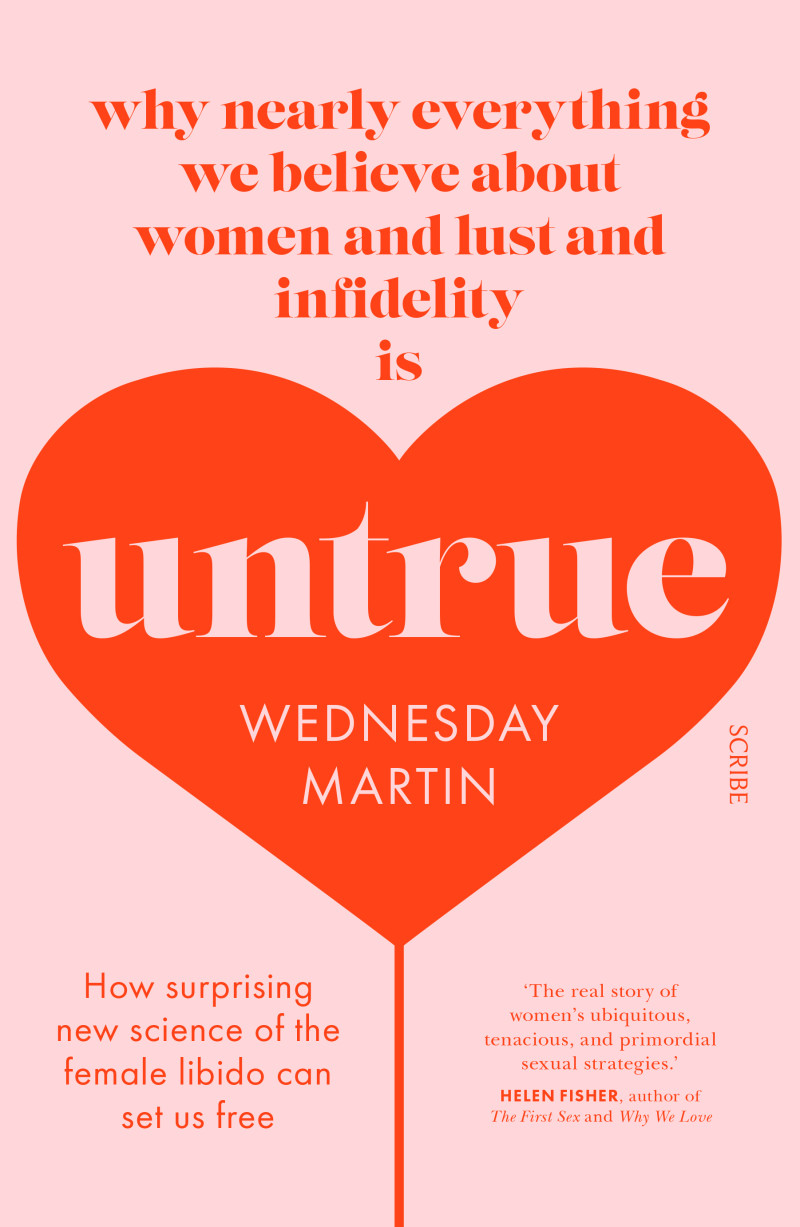
Untrue and Female Sex Instincts

An anthropologist suggested that I read the book Untrue by Wednesday Martin for an example of a good treatment of modern thinking on evolved behavior, and I’m glad she did. The book has some great takes on sex instincts, particularly those involved in female “extra-pair coupling”, as the biologists call it. It’s not the first book I would recommend on evolution and sexuality, but I got a lot out of it.

Men of faith and men of science have long described women’s sexuality in limited terms, and Martin shows how wrong these simplistic views are. In civilizations east and west, men have defined a wife’s infidelity as a sin or a biological aberration. Martin demonstrates that extra-pair coupling is indeed part of the human female’s sexual repertoire. While women have been relentlessly programmed to be submissive and faithful wives, Martin shows that women have sex drives that send many wives seeking partners other than their husbands. The brain evolved for behavioral flexibility, and human behavior is facultative. That is, we have more behavioral routines that we ever use, and we use the ones that fit any given situation. Studying psychology in the 1980s, I was taught that society conditioned people so that socially constructed behavior patterns, such as gender roles, seemed natural. Untrue shows just how limited any such conditioning is, as women’s instinctive drives lead many of them to break the rules they were supposedly conditioned to internalize.

Western civilization, notes Martin, has tried to define women’s sexuality as passive, the supposed counterpart to the active male. But this passive role doesn’t stick, and in real life women are not passive but responsive. That’s a great clarification. Speaking personally, I prefer “responsive” to “passive”. 

Biologists talk about “female choice”. Among mammals in particular, females invest so much of their own lives and energy in their young that they can be choosy about which males impregnate them and thereby get a “free ride” on all their blood, sweat, and milk. In historical civilizations, however, families have exercised oppressive control over their daughters’ choices. Female choice is on full display when Martin discusses Ashley Madison, the web site for wives who wanted to cheat. The women on that site were able to specify, sometimes down to penis size, the sorts of lovers they would consider taking.

In evolutionary terms, it pays off for a female mammal to mate with a high-status male, since doing so increases the odds that one’s sons will achieve high status. That behavior is called called hypergamy, and in human society it commonly appears as women “marrying up”. In fairy tales, the commoner girl marries the prince. Martin provides us with great example of hyergamy with the housewives of the 50s and 60s who carried on affairs with their husbands’ superiors. Eventually, the women left their lower-status husbands in favor of their new, higher-status mates. So much for being programmed to passivity.

For the readers who might think that gender roles can be constructed any which way without regard to universal human predispositions, Martin cites anthropologist Agustin Fuentes as saying that there are indeed half a dozen instances of gender-role differences that are universal among humans.

Untrue has a lot more details, such as the author’s visit to a “skirt party” for adventurous women, but my take-away is the power of primeval instincts in the face of modern attempts at socialization.

Sex at Dawn, by Christopher Ryan and Cacilda Jethá: Untrue shows that sexual instincts make themselves felt in today’s society, and Sex at Dawn covers a more explicitly evolutionary take on the topic. Martin mentions this book, and I’ve recommended it before, but I hear that science people aren’t impressed with it, so haven’t been recommending it lately.

The Red Queen, by Matt Ridley: This book is my top recommendation for the science of sex, including bacteria, millipedes, parasites, and more. I hoped it would be a good overview of humanity’s evolved sexuality, but it is way more than that. More people should read this book. 

Sunday, March 31, 2019

2019

Two timers, no waiting

Timing Group Discussions

Previously, I’ve posted about the problems I’ve seen during free-form discussions, specifically where some people talk more than they need to at the expense of others. When I teach my game-design class each fall, my rule is that students have to raise their hands and be called on. Without that rule, students with certain personality types would speak up more than their share. (The Y-chromosome seems to correlate with this behavior.) When I moderate panels at conventions, I give each member of the audience one chance to ask a question or make a comment before anyone speaks a second time. Otherwise, the quiet members of the audience are shut out while the talkative members get more than their share of attention. I’ve got a new trick that I’m using for a discussion of Jonathan Haidt’s The Righteous Mind: using one-minute hourglasses to give each participant a one-minute spotlight. We start the discussion with a round of one-minutes statements from each person, about a dozen of us.. Then we discuss things more less freely, after which we have a second round of one-minute comments near the end of the 90-minute session. There’s some time after the second round for discussion, but not much. The people in the book discussion group say they like the new system with the timers. 

The trick is to get two timers. We go around the circle and give each person a chance to speak. The first speaker turns over their one-minute hourglass, and when they’re done they hand the hourglass to the third speaker. If the hourglass hasn’t run out, the third speaker lets it run out while the second speaker talks. When the first speaker has finished, the second speaker turns over their hourglass, and when they’re done, they hand the hourglass to the fourth speaker, etc. You could use an electronic timer that restarts instantly, and then you wouldn’t need two, but where’s the fun in that?

I have seen single one-minute hourglasses used before, but they’re awkward when the previous speaker still has time left in their hourglass. I copied the two-hourglass system from a Unitarian meeting about climate justice. Having little props to fiddle with is fun. The timers may be a little dorky, but one thing I like about us Unitarians is that we’re not afraid to be a little dorky together. The Science Book Discussion group that’s reading The Righteous Mind is also through my Unitarian church. 

The one-minute timer is just one way to manage a conversation with a lot of different people and different personalities. My point isn’t that you should use my particular system. My point is that open-format discussions are systematically unfair and that everyone running a discussion needs ground rules or protocols of some sort to even things out better. 

PS: One-minute timers. If you’re in Seattle, you can get one-minute hourglasses at Top Ten Toys in Greenwood, like I did. It’s a neat store. 

Previous blog post. Talking Over Women: Misadventures in atheist meet-ups (October 2014). 


Sunday, February 24, 2019

Resources for Studying The Righteous Mind

The book I recommend the most. 
Jonathan Haidt’s book The Righteous Mind is the book I recommend the most. It has changed the way I understand political conflict. Irrational behavior that used to baffle me, such as denying evolution or thinking Saddam Hussein was behind 9/11, now makes perfect sense to me. Haidt shows how political and religious conflicts are grounded in evolved, moral feelings. These feelings provide us with moral judgments, for which we then invent justifications so plausible that we believe them ourselves. This analysis informs the moderated dialogs that a friend and I have been running in Seattle for years. Now at my Unitarian church, I’m running a book discussion group on The Righteous Mind, and I’ve collected links to a few good, online resources for anyone who wants to understand what Haidt is saying here. 

Bill Moyer and Jonathan Haidt
This is reportedly the best video to get an overview of the book and to see what Haidt looks and sounds like. 50 minutes, video. Link

Jonathan Haidt and the On Being Project
Good introduction, with extra emphasis on religion and Judaism. 50 minutes, audio. Link.

Figures and images
The figures and images from the book. You can pick up a lot just by reviewing them. Link.

YourMorals.Org research site
Learn about your moral feelings while helping researchers calibrate their tests. This site let me create a group just for people in my church, so we can each see how we compare to others in the church who took the same test. You can spend hours here. Link.

The OpenMind platform
This online program helps you coordinate productive conversations within your organization. The introductory tutorial and interactive quizzes are eye-opening even if you never use this platform with a group. The introductory exercises take less than 90 minutes. Link

Fan page
A fellow Unitarian-Universalist wrote up his notes on the book, with a fun chimp-bee graphic. Link.

Link to more resources
A whole page of links to talks or videos that cover the topics in The Righteous Mind. Link


Sunday, February 17, 2019

Calls to Liberal Action

Faux call to action
What policies or efforts can we support today in order to promote Martin Luther King’s vision of a better America? Maybe… 
  • Medicare for all
  • guaranteed income
  • taxes on wealth
  • higher taxes on high incomes
  • legal weed
  • an end to private prisons
  • closing gun-purchase loopholes
  • promoting education and training
  • investing in green jobs and infrastructure. 

We have plenty of directions to choose from. In January, it was heartening to see so many Seattleites joining in the Martin Luther King march. There’s obviously a lot of energy around confronting injustice and inequality, which is great to see. What concerns me, however, is that the liberal project seems to have lost its momentum in the last five years or so. For a hundred years or more, we’ve seen liberal progress, but recently things seem to have gotten worse, not better. One unfortunate thing I noticed at the MLK march is a trend that I’ve seen elsewhere: a lack of calls to action. Protest signs at the march mostly seemed to declare what people are against rather than what we hope to accomplish. Declaring one’s opposition to bad things is easier than proposing a practical course of action, but it’s action that counts. Maybe if we liberals could put more effort into figuring out what we need to do next, then we could get moving in those directions.

If you go back 50 years or 100 years, the amount of liberal progress that we’ve made has been tremendous. Gay marriage, Obamacare, Americans with Disabilities Act, Roe v Wade, interracial marriage (my favorite), Civil Rights legislation, the Great Society, rights of the accused, the New Deal, and women’s suffrage. But if you go back just the last several years, one sees a string of failures: the Zimmerman acquittal, BLM’s attempt to reform policing, NoDAPL, Shaun King’s injustice boycott, and the attempt to keep the Republican candidate from winning the 2016 election. There’s a lot of energy on the left, but not a lot of results. I’m a natural science guy and not a political theory guy, so I want results.

Maybe one thing that keeps us lefties from winning more is that our calls to action are ineffective. For the last several years, I’ve noticed a lack of good calls to action from the left. See, for example, the documentary Thirteenth, which impresses on viewers the horror of mass incarceration but ends with no call to action. This year, the MLK march also demonstrated a distinct lack of calls to action. For example, a big sign that I’ve seen at earlier marches declared “Trump/Pence Must Go”. Great! I agree. What does that mean? Does it mean vote Dem in 2020? Impeach? Does it mean, let’s engage in violent rebellion against the US government? Engage in a national strike? Share memes on social media? 

My sign.
Next year, a call to action.
Plenty of other signs were phrased as if they were calls to action, but they really weren’t. Consider “Smash the Patriarchy”, “End Racism”, “End Racial Disparities Now”, and “Resist”. Those sound good to me. What’s step one? What’s the plan? What’s the timeline? Within the plan, what are the highest priorities? These are faux calls to action, and they come across more like creeds. Everyone who wants to “smash the patriarchy” can find each other thanks to signs like these. But once they have found each other, what will they do next? Burn down a bank? Castrate toxic males? Share devastating memes on Twitter? The beauty of a religious creed like the Trinity of Father, Son, and Holy Ghost is that it requires no change in actual behavior. Any Christian can affirm the creed that Jesus is fully human and fully God without being bothered to donate their wealth to the poor or to evangelize for the Lord. Creeds are easy. As with a creed, social justice advocates who want a better world can affirm a shared desire to “smash the patriarchy” without committing to any particular action. 

An actual call to action combines two things people don’t like: making a decision and taking a risk. To say “Legalize weed”, one has to decide that legalizing weed is a good idea, to decide that it’s a political struggle worth taking on, and to risk being wrong on both counts. Avoiding the risk of making a decision has built-in appeal, but those of us committed enough to carry signs should be willing to go the extra mile and accept that risk. The attraction of a faux call to action is that it feels powerful, but it risks nothing. 

Recently, we on the left have stopped achieving our goals. In fact, we have failed to set realistic goals in the first place. It takes real work to figure out what to do next, and we should do that work. Legalize weed. Medicare for all. Legalize prostitution. Tax wealth. Tax capital gains like wages. Tax high incomes. Get a Democrat elected president. There are lots of good directions forward, and we should point the way.

2020 addendum: I learned that King called on people to change policy and expect that hearts would follow. His entire “Other America” speech is worth a listen, especially as he directly addresses the controversial topic of rioting. Link

Sunday, January 27, 2019

Darwin Day: A Holiday for Us

A good evolution book
available used for under $10
Evolution is a powerful idea for us secular folks. Back in 2013, when I would tell people that I had a plan for a children’s book on evolution, their eyes would light up. Their reflexive enthusiasm told me that I should take my book to Kickstarter, and the following year Karen and I raised over $30,000 for Grandmother Fish. Secular adults like seeing evolution as a kids’ book because it is our origin story. There are few things that secular people have in common, and evolution is one of those things. Secular people don’t want to rally around a flag or recite a creed, but evolution is an origin story that includes everyone. It’s universal, not parochial. Karen and I knew that parents would like Grandmother Fish, and once the book was published we could see that kids love it, too. Kids love animals, they love families, and they love seeing where they fit in the family of animals. The power of evolutionary thinking, especially for kids, means that Darwin Day has a lot of potential for exciting the imagination. I’d love to see Darwin Day celebrations catch on around the world. 

Those of us who are enthusiastic about evolution are lucky in that our “patron saint”, Charles Darwin, was someone worth emulating. Darwin was already a famous, widely read naturalist before he proposed the theory of natural selection. As a scientist, he observed closely and wrote cogently. He had found through experience that he was more likely to forget a fact if it was a fact he didn’t like. After noticing this pattern, he made special note of facts that he didn’t like. Darwin’s encounters with people from far and wide showed him that people are more alike than different, and his critics thought that his theory made him irrationally soft-hearted toward “primitive” people. We could use more people like Charles Darwin.

Darwin Day works great as a kid-friendly celebration. Kids love animals, especially dinosaurs, and the connection to evolution is clear. Bringing kids to a Darwin Day event makes sense in evolutionary terms. The relationship between parents and children is central to natural selection. Evolution is about whose DNA gets spread into the upcoming generations, and parental care has been central to the success of mammals, not to mention birds, scorpions, lobsters, wasps, and octopuses. By bringing a kid to the event, you’re parenting, or, if it’s someone else’s kid, alloparenting. Most of the activities I have run are for kids, such as the Charles Darwin Dance, but some are for adults. 

Darwin Day traditions, I propose, should include buying evolution-themed books for children, teachers, schools, or libraries. May I recommend Evolution: The Story of Life by Douglas Palmer? It’s a big, weighty book full of color illustrations, and you can get it used for under $10, including shipping within the US. For little kids, this book has tons of illustrations with countless unusual creatures. For older kids, it has lots of handy science information. It helped me with Grandmother Fish, with Clades, and especially with Clades Prehistoric. For adults, the book is a monumental reminder of mortality. In spread after spread, you see animals that were successful in their day but that went extinct long ago. If instead of a book you want to give an evolution game, that works for me, too. 

I hope you can find a Darwin Day event near you. Here in Seattle we’re lucky to have a kid-friendly Darwin Day celebration on February 9th, with The Reptile Guy to put on a show that sounds amazing. If you don’t have a Darwin Day celebration in your area, maybe talk to some people about starting one next year. 

Seattle’s Darwin Day, hosted by Seattle Atheist/Agnostics
Saturday, February 9, 2019
2:00 to 6:00, show starts at 3:00
The 2100 Building
2100 24th Ave S, Seattle, WA
Donations warmly accepted. 

My evolution activities for kids and adults, including the Charles Darwin Dance. 


Monday, January 21, 2019

Evidism and Respect for Evidence

In the book Sharing Reality, Jeff T. Haley and Dale McGowan promote the idea that we science-oriented secularists should promote not particular philosophical conclusions but instead a disciplined respect for evidence. They point out that religions have been becoming more evidence-oriented, and they would like to hasten the trend. The two suggest a neologism—evidism—as the term for this approach to personal belief and public policy. In the tribal conflicts between atheists and believers, it’s easy for atheists to focus on hot-button issues, such as nativity scenes or the Ten Commandments on public land. Haley and McGowan propose that we should instead focus on respect for evidence and on spreading the norm that policy-makers use evidence to guide them. They have a point. “Evidence” is a winning touchstone to help people agree and collaborate. 

At Seattle’s March for Science in 2017, I said that evidence can bring people together. Sharing Reality makes a similar point. An advantage of pointing people toward evidence is that almost everyone says that they value evidence and thinks that they value it. Atheist PZ Myers makes the point that creationists try to bolster their position by portraying it in scientific terms. For example, they love to talk about the laws of thermodynamics, as if natural selection contradicts those laws. Even the people who disagree with scientists still affirm the authority of science. Likewise, almost everyone affirms the importance of evidence. Will evidence really convince anyone that they’re wrong? But without evidence the odds are zero. The authors expand on the topic at length, discussing the value of evidence and the best ways to communicate the importance of evidence. They show how a respect for evidence leads naturally to agnostic and secular behavior, even for people who believe in God and scripture. 

In my personal experience, I can confirm that people usually can’t ignore the importance of evidence even when they wish they could. People arguing on the Internet often rely on abstract arguments, but they recognize the value of evidence when you ask them for it. Focusing on the evidence might not change the mind of one’s opponent in a debate, but it impresses the audience. 

The term “evidism”, however, doesn’t grab me. If lots of people start using the term, I won’t be the last, but I’m not going to be the first, either. I’d rather call it empiricism. For some people, empiricism has negative connotations suggesting soullessness or faithlessness. That’s fine by me. I’d rather use a word that people care about than one that they don’t. 

Haley and McGowan say that believing in God demonstrates that the believer isn’t following the evidence, but I would not make the same judgment. While the authors reluctantly agree that it would be worth working with science-oriented believers, I would be enthusiastic about it, not reluctant. I don’t care if someone believes in God, but I do care if they respect science. I have more in common with an evidence-oriented believer than with an atheist who thinks that reality is constructed by language, by power hierarchies, or by the power of positive thinking.

Sharing Reality makes an important point, that focusing on evidence is a promising way to improve dialogs about policies, injustices, and other issues of general concern—especially with religious people. 


Sharing Reality: How to Bring Secularism and Science to an Evolving Religious World. 
By Jeff Haley and Dale McGowan. Pitchstone Publishing (US&CA), 2017

Sunday, February 4, 2018

Evolution Unites Us All

Protesters in New Mexico
In 2017, New Mexicans crowded into a public hearing to speak up for scientific literacy, and the state Department of Education listened. Citizens criticized the department’s plan to drop climate change, the age of the Earth, and evolution from the science standards. In response to backlash, the DOE dropped its plan to edit the standards. Instead it will follow the Next Generation Science Standards in full, as developed by a consortium of states and organizations, such as the National Science Teachers Association. This news is a welcome change in a world that has increasingly rejected evolution science. Recently, governments from Turkey to Florida have been undermining children’s education in evolution. Our kids deserve a scientific understanding of who we are and where we came from. Evolution is more than just the bedrock of biology. Humans evolved from earlier life forms, and a scientific understanding of that fact promotes self-understanding and justice. From biology, we learn that each of us is born unique, that we are related to all life on Earth, and that we are connected to each other.

The theory of evolution tells us that humans can never fit neatly into categories. Natural selection works because the organisms in a population always vary among themselves. Today we need this lesson especially in the realm of gender diversity. Human brains prefer simple binary thinking, so it’s common for people to consider “male” and “female” to be all there is to say about gender. Obviously, we see more diversity than that, and biology tells us why. Biology is messy. The concepts of “male” and “female” are handy shortcuts, but the messy truth is that all sorts of different developmental processes contribute to that dichotomy, and human populations exhibit variety in all those processes. Generating adult male and female humans requires many steps. The fetuses’ genitals develop, their brains masculinize or feminize, the infants experience life either revved up on testosterone or not, children develop gender identities, and they develop sexual attraction. Finally, puberty hits and hormones activate the hormone-sensitive brain structures that were laid down during fetal development. Humans differ from each other in all those biological processes, most commonly in terms of sexual attraction. If all this built-in gender variety isn’t enough, the brain evolved for behavioral flexibility, so of course humans express more variety than found in our genes and hormones. Opponents of gender diversity treat is as if it were a violation of an ultimate, binary division, but evolution says that variety is our birthright.

Paradoxically, while the theory of evolution affirms that we are each unique, it also tells us how much we have in common with the rest of the living world. Traditionalists say that humans are essentially separate from animals, but evolution says we are in fact animals. When I was working on Grandmother Fish, Eric Meikle of the National Center for Science Education impressed on me that the core message of evolution is, We are all related.” We need this lesson today because scientists say that we are driving our planet into its sixth global extinction. Sixty-six million years ago, an asteroid wrecked the planet, but today the villains are climate change and habitat destruction. The theory of evolution tells us that the species we wipe out are our flesh and blood. The polar bears and all other living things are literally our distant cousins. Furthermore, just as all living things are one family, all humanity is one human race, as Darwin himself recognized. In fact, the entire Homo sapiens population today is just one closely related branch of the human race, which until recently included the Neanderthals, Denisovans, and more. Evolution science says that those of us on humanity’s one remaining branch are more alike than different.

Evolution tells us that we are related to all people not only by our shared DNA but also by our shared social instincts. Zoologists call a species like us “obligatorily social.” In everyday terms, we need each other. If you think that hell is other people, anyone in solitary confinement can tell you the opposite. For the human animal, sociality comes built in. Our natural habitat is not the savanna but the tribe. Our smile, for example, is an instinctive sign of happiness, and it functions only in a group. Our eyes also have white scleras so one human can see where the other is looking. Other primates have dark scleras so that competitors can’t track their gazes, but we humans are born to work together. According to social psychologists such as Jonathan Haidt, caring for others is a moral imperative that our ancestors evolved long ago. Today when politics is so divisive, maybe the theory of evolution can remind us of the value we all place on the primeval drive to care for each other.

Evolution says we are all unique, all related, and all bound up in each other’s destinies. Let’s take that to heart. Opponents of evolutionary theory are undermining the scientific understanding of human origins, gender diversity, and human nature. In this time of cultural conflict, let’s speak up for science like the people of New Mexico did in 2017. Let’s honor our connections—to our neighbors, to all humanity, and to the entire living world.