Showing posts with label evolution. Show all posts

Sunday, October 25, 2020

Group Instincts and Modern Politics

Identity without biology


tl:dr Some aspects of our identities activate in-group social instincts, and it’s easy for people to organize politically along those lines. Other aspects of our identities relate more to distinctions within the in-group or within a family structure, and it’s difficult to organize politically along such lines. 

Why is it so much easier to organize African Americans around fighting racism than it is to organize poor people around fighting poverty? Why is it easier to convince poor, white Americans that Muslims are a threat than to convince them that the rich are taking more than their share? Fifty years ago, Martin Luther King tried to unite poor whites and Blacks, but that dream died with him. Why the big difference? Maybe the difference derives from humans’ in-group and out-group instincts.  

Our tribal instincts organize our brains to respond to tribe-versus-tribe conflicts with much stronger emotions than when they respond to conflicts within the tribe. As a result, Christians and Muslims are primed for conflict, while poor people don’t find it natural to organize as a class or group. Below I’ll offer a basic take on nine aspects of identity, pointing out how some of them activate the brain’s tribal programming pretty well while others fail to do so. 

Nine Aspects of Identity

This list comes from the “ADRESSING” model of identity and oppression (see end of post).


Age

All human societies recognize age categories within the group, and these are grounded in biology. Nobody identifies as, say, a “teenager” the way people identify as “Germans” or “Catholics”. 

Tribal Politics: It’s an in-group distinction, and it has low political salience. 


Disability

Disability is a biological reality with broad social implications. Disabled people organize politically, but disability is not a source of identity the way language or religion can be. 

Tribal Politics: In-group, low politics. 


Religion

Religion uses symbolism and ritual to unite people, and before modern times it was the only way to unite different tribes or nations. It’s a breeze to re-orient religious enthusiasm and convert it into hostility toward outsiders. Today, we see hostility across religions lines all over the globe. 

Tribal Politics: Religion distinguishes between “us” and “them”, and it has high political salience.


Ethnicity

Ethnic identity traditionally determined one’s nation, language, religion, and homeland. Armenians, for example, belonged to Armenian culture, and a Navajos belonged to Navajo culture. Today, of course, everything is more complicated, as it was, for instance, in the Roman Empire. Still, even today it’s easy to get most people to identify emotionally with their ethnic groups, especially when there are conflicts with other groups. 

Tribal Politics: Between-group, high politics.


Social Class/Culture

People commonly admire the successful people in their own “tribes.” My daughter loves BeyoncĂ© because BeyoncĂ© is a boss. Like chimpanzees and bonobos, humans defer to high-status individuals within the group. How easy is it for the rich to keep the poor divided by race and nationality? Way too easy. In some societies, class and ethnicity align more or less well, especially when class definitions are explicit and legally enforced. When not linked to ethnicity, class still comes with some of ethnicity’s trappings, such as distinctive dress or accents. 

Tribal Politics: In-group or between-group, middling political salience.


Sexual Orientation

Sexual desire operates on its own agenda, cutting across lines of social identity, and often at odds with a conservative religious identity. Oppression and hostility give the LGBTQ+ crowd good reason to organize politically, but “tribe-style” identities seem powerful compared to sexual orientation. 

Tribal Politics: In-group, middling politics.


Indigenous Background

This category is a special case of the more general tendency to form exclusive groups based on ethnicity and nationality (especially in the broad sense). 

Tribal Politics: Between-group, high politics. 


National Origin

Humans are unusual among social animals in that we can tell which strangers are in our society and which are not. A nation is a level of social organization above the tribe, historically allowing tribes to work together and allowing strangers to trust each other. Traditionally, nations have been defined by shared language, religion, lifestyle, and ethnicity. Consider Armenians, Navajos, Danes, etc. Largely, the point of a nation is to get people within it to treat each other better than they treat outsiders. Nearly all Americans, for example, would say that our federal government should concern itself more with our well-being than with the well-being of Argentinians. Politically, it’s easy to get people riled up about their nation, and something like a massive terrorist attack can get even liberal intellectuals to put flag stickers in their car windows. 

Tribal Politics: Between-group, high politics. 


Gender

Traditionally, men and woman have often had single-sex social groups, but our tribal instincts are organized to unite men and women in the tribe with each other and against the enemy rather than to unite women against men or vice versa. Gender may be an important part of one’s personal identity, but it’s not typically a political identity. In fact, filling a man’s role often means competing with other men for status, and the same goes for women.  

Tribal Politics: In-group, low politics. 


The Nonbiological ADRESSING Model

Leticia Nieto’s model of identity and oppression treats these nine aspects of identity as if they are all analogous to each other, with no real sense that humans are flesh-and-blood animals. Being Black, in this model, is essentially like being disabled. My late wife was both Black and disabled, and I can tell you that these two aspects of one’s identity are not essentially the same. In college I studied 20th century social sciences, and half of what I learned was well-meaning bogus stuff that I later had to unlearn. Nieto’s ADRESSING model fits the pattern of 20th century social science because it’s formulaic and nonbiological.


Missing Aspects of Identity

Three biologically potent aspects of identity are missing from the ADRESSING model. 

Language is a primal indicator of who is “us” and who is “them”, as people with thick accents can tell you. Little children seem to intuit identities based on language at an earlier age than identities based on race. The high political salience of language aligns with that of ethnicity, nation, and religion. Say yes to the Oxford comma, or else let’s fight!

Family is a primal source of personal identity, especially perhaps the mother-child connection. It has low political salience in general. The conflict of “young versus old” gets some traction, but that isn’t exactly a conflict between offspring and parents. 

Individual flesh-and-blood reality—the “crazy diamond” of one’s own unique phenotype—can be a major aspect of one’s personal identity, especially for those of us who diverge from the average in mental or physical terms. Political salience is low.

See Also

My review of The Human Swarm by Mark Moffett, which explains the unusual human penchant for identifying not just with clans of people we know but also with larger societies of people who are “us” even though they’re strangers.

What Jonathan Haidt’s The Righteous Mind means to me and resources for learning about it. 

Sunday, October 18, 2020

Crow Scientist is Live

For years, I’ve been fascinated by crow behavior, and now I have something to show for it. It’s the free app that shows kids how to observe crows the way a scientist does, and for this project I had the pleasure of working with John & Colleen Marzluff. It was a real treat to learn about crows from the experts. We talked for the first time in May, and the app is done already, with Karen Lewis’s art and all. We need feedback from players, and we need 5-star reviews. Here’s a link to the official Crow Scientist page.

The app naturally relates to my overall goal of teaching evolution science to children. Specifically, it teaches two important lessons about natural selection. First, what allows animals to survive is their behaviors. Kids observe crows and note their behaviors on checklists. Second, animals have lots of offspring, most of which die. One checklist is for breeding season observations, including young crows ending up killed. 

Doing the heavy lifting for the app was David Marques, who also published Clades Solo. He’s a creative partner as well as the programmer, and he added a wonderful feature to the app: you can add in your own photos of the behaviors you see. I’ve started adding my own photos, and it’s silly how fun it is. Players can even submit their photos to Phosphorlearn for possible use in the app. 

Kids can also submit their crow art, which the Lead Crow Scientist will post on Instagram. That’s Colleen Marzluff. She’s passionate about kids, nature, and science. You can submit art on the Phosphorlearn page or contact Colleen directly on Instagram.


Friday, September 20, 2019

Review of The Human Swarm by Mark W Moffett

The book I didn’t know I needed.
The Human Swarm by Mark W Moffett is the book I didn’t know I needed. It covers a topic that’s been missing from the discussion of human society, and the perspective it offers fills gaps in what I’ve learned from other books. Moffett covers the topic of anonymous societies—animal groups in which other animals are identified as “members” even by individuals that don’t know them personally. An Argentine ant, for example, can be accepted by other Argentine ants of its super-colony even hundreds of miles away from its origin, using scent as a marker of belonging. Likewise, Mohawk Indians were able to identify and welcome each other even when they didn’t know each other, thanks to their distinctive hairstyles. Moffett identifies a sort of social organization that is highly unusual in the animal kingdom. A more common arrangement is a flock, herd, or nesting colony, where individuals that don’t know each other get along, and that’s because no individuals are excluded. In intimate bands or families, by contrast, only individuals who know each other are welcome. For a small number of animal species, however, a society consists of individuals that can identify each other as “compatriots” without knowing each other personally. This social organization is found among Argentine ants, scrub jays, and humans.

It’s no coincidence that Moffett’s mentor was E O Wilson, the ant expert who revolutionized our understanding of human nature with his book Sociobiology (1975). It’s humbling and exhilarating how much we can learn about human society by comparing and contrasting ourselves to ants. For my purposes, Moffett’s description of Argentine ants was worth the price of the book. Unlike other ant species, Argentine ants form super-colonies with multiple queens. In Argentina, these super-colonies are kept in check by only one thing: other super-colonies of Argentine ants. In California, where the Argentines are an invasive species, they spread almost without limit. Again, their only limit is another super-colony, which is invasive itself. The comparison to humans is elementary.
E O Wilson hugging Grandmother Fish
h/t Greg Epstein

One of the revolutionary findings of contemporary psychology is that humans are “groupish”, as Jonathan Haidt puts it in his seminal book The Righteous Mind (2012). Freud taught that humans are inherently selfish, but intellectuals of his day had no clear understanding of human evolution or prehistory. Now we understand that humans are innately social, a trait that we can trace back tens of millions of years to our early simian ancestors. Morality, as modern researchers contend, is an adaptation that helps us get along in groups of our peers. Moffett’s insights help us see this “tribalism” on the scale of anonymous societies. Sure, it’s easy to understand why people prefer their friends and kin over strangers, but this book illuminates the human practice of preferring people we don’t know provided they have the right hair styles, modes of dress, manner of speech, or other societal markers. This book unifies Haidt’s modern-day insights, the globe-spanning analysis of Francis Fukuyama’s The Origins of Political Order (2011), and other big-picture books about the nature of human society and the human animal.

The Human Swarm does an admirable job of surveying the topic on all levels: ants that are more or less specialized, spiders that impersonate ants to predate them, chimpanzee bands with their distinctive pant-hoots, bands of humans who know each other as kin, groups of human bands that cooperate across societal boundaries, groups of human bands that split to create new boundaries, and today’s bewildering mix of human populations. This book is worth your time just for the information about whales and scrub jays. Moffett knows that he is filling in the blanks left by previous ethologists and anthropologists, and this book is a treasury of both big ideas and delightful details. Perhaps the most important information for understanding human societies is the material on non-state societies and the bands that compose them. Here we see the many ways that humans have marked membership in their societies and the xenophobia toward outsiders that was the default perspective.

Disclosure: E O Wilson is a fan of my children’s book, Grandmother Fish, so any friend of his is a friend of mine.

Sunday, July 21, 2019

Not "Race" but Ancestry

Modern genetics says there are no
homogeneous, essential “races”
tl;dr I used to think that “race” meant nothing, biologically speaking. Now I think it means not much.

In the 80s, I studied race as part of my BA in sociology, and I was proud to learn views that represented the best science. Experts such as Richard Lewontin and Stephen J Gould taught that what we think of as “race” does not correspond with human ancestry or meaningful biological differences among groups. Gould, perhaps the most storied popularizer of evolutionary thinking the 20th century, said, “There’s been no biological change in humans in 40,000 or 50,000 years”. Cultural change had taken over, the experts said, and biological change had ended. Based on that scientific understanding, it was impossible that people of different “races” could be biologically distinct in any way. Learning this view, I considered “race” to be as irrelevant to biology as astrological signs are. That was the 80s. Since then, two things have happened that led me to adjust my views, albeit not to reverse them. Personally, I married a black woman, and we raised a biracial daughter together. Scientifically, geneticists mapped the human genome. Based on new evidence, I now see differences in continental ancestry as biologically real but still mostly insignificant. That position contradicts today’s racists, who want us to believe that “racial” differences are telling and definitive. It also angers people who either still believe what Gould and Lewontin taught in the 80s or who think that we shouldn’t talk about the new evidence because it’s too problematic. A recent study suggests that teaching students the facts of human genetic variation leads to a significant reduction in prejudice, and that sounds great to me. The alternative—not talking about the new findings—means that racists can tell potential recruits that we egalitarians are hiding scientific information. If we act like we’re afraid of these findings, it helps racists spread the lie that the new findings are a threat to our egalitarian ideals. Our society has a problem with the return of racist pseudoscience. My view is that the best way to counter pseudoscience is to use good science.

Sometimes when people hear me talking about differences among “races”, they jump to the conclusion that I endorse all the claims people make about such differences, such as alleged innate differences in IQ. Let me clarify in advance that my point is just the opposite, that we should distinguish the claims that have scientific support from those that don’t. Here for example, is a study that distinguishes between certain medically-relevant differences (supported by the evidence) and cognitive differences (what the racists want you to believe). The racists want people to consider all these claims as equally valid—all good. Certain of my fellow progressives agree with the racists to the extent that we should consider all these claims to be equally valid, although with the idea that they should all be rejected. Treating all these claims as alike in their value seems to be a mistake because it puts racist pseudoscience on the same footing as research you can find on PubMed. 

In 1992, I married a black woman secure in the knowledge that humans from all over the world are basically the same, and nothing I’ve learned since then has changed my mind about that. Despite whatever genetic differences there may be from one group to another, a man and a woman from any two places can have healthy, normal children together. The large differences among the “races” are socially constructed differences, while the biological differences are minor. My wife passed away in 2008.

In 1994 when our daughter was born, a nurse told me that she was physically advanced. I made some joke about my good genes, and the nurse responded by telling me that black newborns tend to be advanced compared to white babies. That response came as a shock to me because it violated expert opinion as I’d learned it. Since this observation contradicted my deeply held beliefs about “race”, I compartmentalized it. Despite the contrary evidence, I still believed that “races” were not just merely social constructs but in fact constructed out of nothing. Thanks to this compartmentalization, it took multiple lines of evidence from different sources and years of mental adjustment before I could see that Gould and Lewontin had simply been wrong. If some of my fellow progressives are angry at me for my views about genetics and human variation, I can sympathize with them because they are the views that would have infuriated me when I was in my 20s.

The other lines of evidence came from genetics and medicine. In medical research, doctors need to know what the biological facts are, regardless of politics. They have found real differences among different populations, although they’re not the sort of differences that racists wish they had found. For example, if you’re looking for a compatible donor for a bone marrow transplant, your continental ancestry* makes a difference. European-Americans are more likely to find a compatible donor among the pool of other European-Americans, and you can say the same thing for other groups. Researchers studying obesity have also found that people of different ancestries tend to carry fat on different parts of their bodies, so an overweight person of East Asian ancestry is likely to suffer ill effects at a lower proportion of body fat than someone of sub-Saharan ancestry.

Another line of evidence comes from genetics. With a sample of someone’s DNA, scientists can determine which continent or continents the person’s ancestry derives from. Personally, I’m northern European. In the 80s, I had been led to believe that human genetics was such a blur that we’d never be able to pinpoint someone’s “race” from their DNA (see “cline”). Now that we’ve mapped our genome, geneticists can identify not only someone’s continental/global ancestry but also which smaller ethnic group they belong to and in some cases which valley their ancestors lived in. For certain ethnic groups, such as East Africans, Uighurs, or Hazaras, geneticists can measure how much of their DNA comes from one continent and how much from another. East Africans represent an admixture of West Eurasian (“Caucasian”) DNA and sub-Saharan African DNA. Uighurs and Hazaras represent admixtures of West Eurasian and East Asian DNA. A close look at the features of people from these ethnic groups seems to confirm these ancestries.

As for Gould’s claim that there has been no biological change for tens of thousands of years, just the opposite is true. Cultural evolution has not replaced biological evolution but instead accelerated it. Domesticating milk-producing animals, for example, has led several human groups to independently evolve adaptations that allow them to digest milk sugar (lactose) in adulthood. Scientists have also identified an adaptation among Tibetans for living at high altitudes and an adaptation for diving among the indigenous Bajau of Indonesia. Gould’s outdated argument against the importance of “race” was that natural selection hasn’t operated fast enough to differentiate people of different continental populations. In fact, natural selection has operated so fast that there’s a new argument against the importance of “race”. Evolution has led to regional differences within each continent, contradicting the idea that continental populations (“races”) are homogeneous. Racists might want to talk about a single “white race”, but Europeans represent an admixture of three “races”: indigenous hunter-gatherers, Anatolian farmers, and finally cattle-herders from the steppe. Sprinkle in a little Neanderthal DNA, and obviously it’s impossible for any white person to be “purely” white. The same goes with any other “race”: they’re all amalgams. These amalgam genomes vary from one valley to the next, so continental gene pools play out as countless variations at the local level. No one of these variations is the “real” genotype or phenotype of that gene pool. 

In addition to changing my scientific view of genetics as new evidence became available, I have also personally become more matter-of-fact about “race”. The views I hold today, as innocuous as they seem to me, would have angered the Jonathan Tweet of 1994, and I’m not surprised that they anger some folks today. So should we talk about the differences that researchers have identified? Maybe I’m wrong, but it looks like avoiding these findings doesn’t work. My daughter and I do not want to see racist pseudoscience gain any more ground, and the practice of avoiding the new evidence has evidently failed to keep the pseudoscience in check. If avoiding the evidence hasn’t worked, what can we do? 

When I spoke at Seattle’s first March of Science, I said that evidence can bring us together. Charles Darwin looked at the evidence and concluded that humans all over the world are the same species, not separately created kinds as certain creationists had concluded. In my children’s book, Grandmother Fish, I coach parents to explain to their kids that we are one human race, all the descendants of “Grandmother Human” (see below). I’m heartened to learn that antiracist researchers have confirmed that teaching the facts of human variation can reduce prejudice. Certainly, some people who share my egalitarian ideals take exception to my approach to human biology, but I don’t bear them ill will. Their motivations are positive even if the way they treat me is negative. Twenty-five years ago, I would have agreed with their criticisms, and that perspective makes it easier for me to be charitable toward them than it is for them to be charitable toward me. My hope is that over the next few decades the power of evidence will lead us to greater agreement.

“If, as scientists, we fully abstain from laying out a rational framework for discussing human differences, we will leave a vacuum that will be filled by pseudoscience, an outcome that is far worse than anything we could achieve by talking openly.” 
—David Reich, Who We Are and How We Got Here (2018)

* AKA “global ancestry”

Links

“Can Biology Class Reduce Racism?” by Amy Harmon. Experimental curriculum uses science to head off students’ racist intuitions.

‘The Native American/East Asian "race"’, using modern genetic science to debunk 19th-century racial categories.

 * * *

“Race”: I put “race” in scare quotes because it doesn’t really exist according to its traditional understanding but there’s no widely recognized replacement term for groups that share continental ancestry. [EDIT: I asked around, and “ancestry” or “genetic ancestry” look like good terms. Link.] [EDIT: Also, “global ancestry”.]

Being Wrong: What it was like for me to be wrong about big ideas.

Speech at March for Science Seattle: Evidence can unite us.

Diversity in D&D: Gender and human “races” in D&D Third Edition (EN World).


Sunday, May 12, 2019

Testosterone for Amateurs

Testosterone drives male
robins to compete
Testosterone is in the news these days. It’s an interesting hormone that gets talked about a lot, especially in terms of human differences. Speaking personally, I value testosterone as one of the things that connects our little human family to the wider family of animals. Here’s what I’ve learned about testosterone over the last 10 to 20 years.
Testosterone (T) is a steroid. It occurs in both men and women, but most men with “low testosterone” have levels that would be off the charts for women. In addition to levels being higher in adult males, they are higher in male fetuses, infants, and adolescents. 
In vertebrates at least, testosterone mediates the development of a masculine phenotype, with “masculinity” meaning different things for different species. The hormone that drives a male robin to face off with other males is testosterone. In the winter, when T levels are low, male robins tolerate each others’ presence rather than fighting. For most mammals, T spurs growth and thus males are larger. For species of lizards in which males are smaller than females, T inhibits growth instead.
The default body plan for mammals is female, with male hormones diverting the embryo toward the male phenotype. An XY mammal that is insensitive to T develops as an infertile female.
In almost all mammal species, testosterone makes males bigger and stronger, on average, than females. That’s true for humans, and men’s upper body strength points to an evolutionary history of physical struggle. The dimorphism in our species, however, is small relative to other apes and nothing compared to gorillas or sea lions. Men don’t have antlers or peacock tails or other outlandish adaptations for out-competing the other males. Our species’ modest level of dimorphism suggests that male-to-male competition over mates has been low, lower than among chimpanzees or orangutans.
Testosterone levels have a large effect on human development and a smaller effect on current behavior. Exposure to T in the womb organizes the brain along male lines, especially with connections that become active when exposed to T at adolescence. In mammals, brains are wired for both male and female behaviors, with males predisposed toward but not limited to male-typical behaviors, and the same with females and female-typical behavior. 
Prenatal exposure to T predisposes a child to rough-and-tumble play and probably to being sexually attracted to women. 
Boys tend to be born larger than girls, especially a woman’s first son. Hormones at puberty increase the dimorphism between the typical males and females.
T promotes the sex drive in men and women. 
Trans men who take testosterone often report changes to mood. 
Each human is individually more or less sensitive to testosterone depending on the length of the “CAG repeats” associated with their androgen receptor genes. The gene is on the X chromosome, so women have two copies and are thus more likely to be in the “average” range of sensitivity. 

Further Reading

The Red Queen: Sex and the Evolution of Human Nature by Matt Ridley. If you want to learn about how sex functions and evolves not just for humans but across the family of living things: bacteria, parasites, millipedes, etc. 

The Female Brain and The Male Brain by Louann Brizendine. If you want to learn how hormones affect individual development and the human experience from embryogenesis to senescence. 


Sunday, April 14, 2019

2019

Untrue and Female Sex Instincts

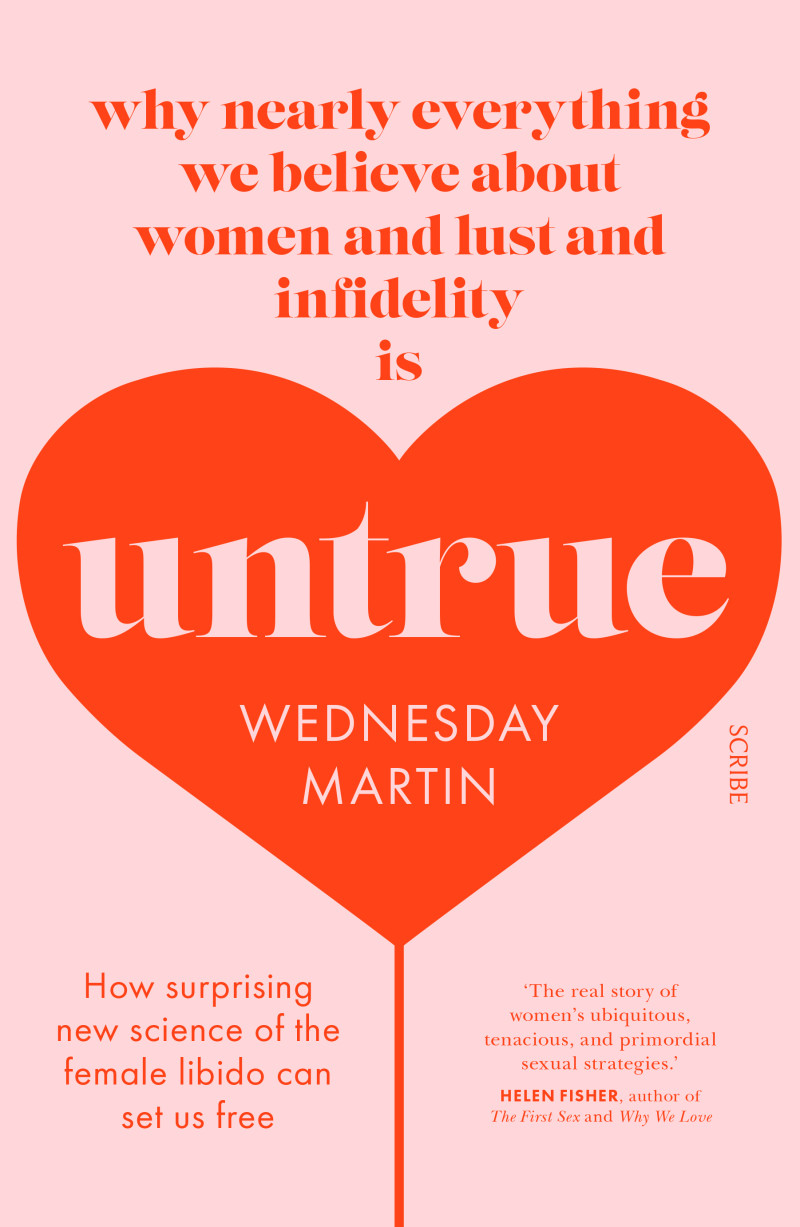
An anthropologist suggested that I read the book Untrue by Wednesday Martin for an example of a good treatment of modern thinking on evolved behavior, and I’m glad she did. The book has some great takes on sex instincts, particularly those involved in female “extra-pair coupling”, as the biologists call it. It’s not the first book I would recommend on evolution and sexuality, but I got a lot out of it.

Men of faith and men of science have long described women’s sexuality in limited terms, and Martin shows how wrong these simplistic views are. In civilizations east and west, men have defined a wife’s infidelity as a sin or a biological aberration. Martin demonstrates that extra-pair coupling is indeed part of the human female’s sexual repertoire. While women have been relentlessly programmed to be submissive and faithful wives, Martin shows that women have sex drives that send many wives seeking partners other than their husbands. The brain evolved for behavioral flexibility, and human behavior is facultative. That is, we have more behavioral routines that we ever use, and we use the ones that fit any given situation. Studying psychology in the 1980s, I was taught that society conditioned people so that socially constructed behavior patterns, such as gender roles, seemed natural. Untrue shows just how limited any such conditioning is, as women’s instinctive drives lead many of them to break the rules they were supposedly conditioned to internalize.

Western civilization, notes Martin, has tried to define women’s sexuality as passive, the supposed counterpart to the active male. But this passive role doesn’t stick, and in real life women are not passive but responsive. That’s a great clarification. Speaking personally, I prefer “responsive” to “passive”. 

Biologists talk about “female choice”. Among mammals in particular, females invest so much of their own lives and energy in their young that they can be choosy about which males impregnate them and thereby get a “free ride” on all their blood, sweat, and milk. In historical civilizations, however, families have exercised oppressive control over their daughters’ choices. Female choice is on full display when Martin discusses Ashley Madison, the web site for wives who wanted to cheat. The women on that site were able to specify, sometimes down to penis size, the sorts of lovers they would consider taking.

In evolutionary terms, it pays off for a female mammal to mate with a high-status male, since doing so increases the odds that one’s sons will achieve high status. That behavior is called called hypergamy, and in human society it commonly appears as women “marrying up”. In fairy tales, the commoner girl marries the prince. Martin provides us with great example of hyergamy with the housewives of the 50s and 60s who carried on affairs with their husbands’ superiors. Eventually, the women left their lower-status husbands in favor of their new, higher-status mates. So much for being programmed to passivity.

For the readers who might think that gender roles can be constructed any which way without regard to universal human predispositions, Martin cites anthropologist Agustin Fuentes as saying that there are indeed half a dozen instances of gender-role differences that are universal among humans.

Untrue has a lot more details, such as the author’s visit to a “skirt party” for adventurous women, but my take-away is the power of primeval instincts in the face of modern attempts at socialization.

Sex at Dawn, by Christopher Ryan and Cacilda Jethá: Untrue shows that sexual instincts make themselves felt in today’s society, and Sex at Dawn covers a more explicitly evolutionary take on the topic. Martin mentions this book, and I’ve recommended it before, but I hear that science people aren’t impressed with it, so haven’t been recommending it lately.

The Red Queen, by Matt Ridley: This book is my top recommendation for the science of sex, including bacteria, millipedes, parasites, and more. I hoped it would be a good overview of humanity’s evolved sexuality, but it is way more than that. More people should read this book. 

Sunday, February 24, 2019

Resources for Studying The Righteous Mind

The book I recommend the most. 
Jonathan Haidt’s book The Righteous Mind is the book I recommend the most. It has changed the way I understand political conflict. Irrational behavior that used to baffle me, such as denying evolution or thinking Saddam Hussein was behind 9/11, now makes perfect sense to me. Haidt shows how political and religious conflicts are grounded in evolved, moral feelings. These feelings provide us with moral judgments, for which we then invent justifications so plausible that we believe them ourselves. This analysis informs the moderated dialogs that a friend and I have been running in Seattle for years. Now at my Unitarian church, I’m running a book discussion group on The Righteous Mind, and I’ve collected links to a few good, online resources for anyone who wants to understand what Haidt is saying here. 

Bill Moyer and Jonathan Haidt
This is reportedly the best video to get an overview of the book and to see what Haidt looks and sounds like. 50 minutes, video. Link. 

Jonathan Haidt and the On Being Project
Good introduction, with extra emphasis on religion and Judaism. 50 minutes, audio. Link.

Figures and images
The figures and images from the book. You can pick up a lot just by reviewing them. Link.

YourMorals.Org research site
Learn about your moral feelings while helping researchers calibrate their tests. This site let me create a group just for people in my church, so we can each see how we compare to others in the church who took the same test. You can spend hours here. Link.

The OpenMind platform
This online program helps you coordinate productive conversations within your organization. The introductory tutorial and interactive quizzes are eye-opening even if you never use this platform with a group. The introductory exercises take less than 90 minutes. Link. 

Fan page
A fellow Unitarian-Universalist wrote up his notes on the book, with a fun chimp-bee graphic. Link.

Link to more resources
A whole page of links to talks or videos that cover the topics in The Righteous Mind. Link. 


Sunday, January 27, 2019

Darwin Day: A Holiday for Us

A good evolution book
available used for under $10
Evolution is a powerful idea for us secular folks. Back in 2013, when I would tell people that I had a plan for a children’s book on evolution, their eyes would light up. Their reflexive enthusiasm told me that I should take my book to Kickstarter, and the following year Karen and I raised over $30,000 for Grandmother Fish. Secular adults like seeing evolution as a kids’ book because it is our origin story. There are few things that secular people have in common, and evolution is one of those things. Secular people don’t want to rally around a flag or recite a creed, but evolution is an origin story that includes everyone. It’s universal, not parochial. Karen and I knew that parents would like Grandmother Fish, and once the book was published we could see that kids love it, too. Kids love animals, they love families, and they love seeing where they fit in the family of animals. The power of evolutionary thinking, especially for kids, means that Darwin Day has a lot of potential for exciting the imagination. I’d love to see Darwin Day celebrations catch on around the world. 

Those of us who are enthusiastic about evolution are lucky in that our “patron saint”, Charles Darwin, was someone worth emulating. Darwin was already a famous, widely read naturalist before he proposed the theory of natural selection. As a scientist, he observed closely and wrote cogently. He had found through experience that he was more likely to forget a fact if it was a fact he didn’t like. After noticing this pattern, he made special note of facts that he didn’t like. Darwin’s encounters with people from far and wide showed him that people are more alike than different, and his critics thought that his theory made him irrationally soft-hearted toward “primitive” people. We could use more people like Charles Darwin.

Darwin Day works great as a kid-friendly celebration. Kids love animals, especially dinosaurs, and the connection to evolution is clear. Bringing kids to a Darwin Day event makes sense in evolutionary terms. The relationship between parents and children is central to natural selection. Evolution is about whose DNA gets spread into the upcoming generations, and parental care has been central to the success of mammals, not to mention birds, scorpions, lobsters, wasps, and octopuses. By bringing a kid to the event, you’re parenting, or, if it’s someone else’s kid, alloparenting. Most of the activities I have run are for kids, such as the Charles Darwin Dance, but some are for adults. 

Darwin Day traditions, I propose, should include buying evolution-themed books for children, teachers, schools, or libraries. May I recommend Evolution: The Story of Life by Douglas Palmer? It’s a big, weighty book full of color illustrations, and you can get it used for under $10, including shipping within the US. For little kids, this book has tons of illustrations with countless unusual creatures. For older kids, it has lots of handy science information. It helped me with Grandmother Fish, with Clades, and especially with Clades Prehistoric. For adults, the book is a monumental reminder of mortality. In spread after spread, you see animals that were successful in their day but that went extinct long ago. If instead of a book you want to give an evolution game, that works for me, too. 

I hope you can find a Darwin Day event near you. Here in Seattle we’re lucky to have a kid-friendly Darwin Day celebration on February 9th, with The Reptile Guy to put on a show that sounds amazing. If you don’t have a Darwin Day celebration in your area, maybe talk to some people about starting one next year. 

Seattle’s Darwin Day, hosted by Seattle Atheist/Agnostics
Saturday, February 9, 2019
2:00 to 6:00, show starts at 3:00
The 2100 Building
2100 24th Ave S, Seattle, WA
Donations warmly accepted. 

My evolution activities for kids and adults, including the Charles Darwin Dance. 


Sunday, February 4, 2018

Evolution Unites Us All

Protesters in New Mexico
In 2017, New Mexicans crowded into a public hearing to speak up for scientific literacy, and the state Department of Education listened. Citizens criticized the department’s plan to drop climate change, the age of the Earth, and evolution from the science standards. In response to backlash, the DOE dropped its plan to edit the standards. Instead it will follow the Next Generation Science Standards in full, as developed by a consortium of states and organizations, such as the National Science Teachers Association. This news is a welcome change in a world that has increasingly rejected evolution science. Recently, governments from Turkey to Florida have been undermining children’s education in evolution. Our kids deserve a scientific understanding of who we are and where we came from. Evolution is more than just the bedrock of biology. Humans evolved from earlier life forms, and a scientific understanding of that fact promotes self-understanding and justice. From biology, we learn that each of us is born unique, that we are related to all life on Earth, and that we are connected to each other.

The theory of evolution tells us that humans can never fit neatly into categories. Natural selection works because the organisms in a population always vary among themselves. Today we need this lesson especially in the realm of gender diversity. Human brains prefer simple binary thinking, so it’s common for people to consider “male” and “female” to be all there is to say about gender. Obviously, we see more diversity than that, and biology tells us why. Biology is messy. The concepts of “male” and “female” are handy shortcuts, but the messy truth is that all sorts of different developmental processes contribute to that dichotomy, and human populations exhibit variety in all those processes. Generating adult male and female humans requires many steps. The fetuses’ genitals develop, their brains masculinize or feminize, the infants experience life either revved up on testosterone or not, children develop gender identities, and they develop sexual attraction. Finally, puberty hits and hormones activate the hormone-sensitive brain structures that were laid down during fetal development. Humans differ from each other in all those biological processes, most commonly in terms of sexual attraction. If all this built-in gender variety isn’t enough, the brain evolved for behavioral flexibility, so of course humans express more variety than found in our genes and hormones. Opponents of gender diversity treat is as if it were a violation of an ultimate, binary division, but evolution says that variety is our birthright.

Paradoxically, while the theory of evolution affirms that we are each unique, it also tells us how much we have in common with the rest of the living world. Traditionalists say that humans are essentially separate from animals, but evolution says we are in fact animals. When I was working on Grandmother Fish, Eric Meikle of the National Center for Science Education impressed on me that the core message of evolution is, “We are all related.” We need this lesson today because scientists say that we are driving our planet into its sixth global extinction. Sixty-six million years ago, an asteroid wrecked the planet, but today the villains are climate change and habitat destruction. The theory of evolution tells us that the species we wipe out are our flesh and blood. The polar bears and all other living things are literally our distant cousins. Furthermore, just as all living things are one family, all humanity is one human race, as Darwin himself recognized. In fact, the entire Homo sapiens population today is just one closely related branch of the human race, which until recently included the Neanderthals, Denisovans, and more. Evolution science says that those of us on humanity’s one remaining branch are more alike than different.

Evolution tells us that we are related to all people not only by our shared DNA but also by our shared social instincts. Zoologists call a species like us “obligatorily social.” In everyday terms, we need each other. If you think that hell is other people, anyone in solitary confinement can tell you the opposite. For the human animal, sociality comes built in. Our natural habitat is not the savanna but the tribe. Our smile, for example, is an instinctive sign of happiness, and it functions only in a group. Our eyes also have white scleras so one human can see where the other is looking. Other primates have dark scleras so that competitors can’t track their gazes, but we humans are born to work together. According to social psychologists such as Jonathan Haidt, caring for others is a moral imperative that our ancestors evolved long ago. Today when politics is so divisive, maybe the theory of evolution can remind us of the value we all place on the primeval drive to care for each other.

Evolution says we are all unique, all related, and all bound up in each other’s destinies. Let’s take that to heart. Opponents of evolutionary theory are undermining the scientific understanding of human origins, gender diversity, and human nature. In this time of cultural conflict, let’s speak up for science like the people of New Mexico did in 2017. Let’s honor our connections—to our neighbors, to all humanity, and to the entire living world.

Sunday, April 30, 2017

Speech at March for Science Seattle

Here’s the 4-minute speech I gave at the March for Science in Seattle, Earth Day 2017, April 22. That’s Karen up on stage with me, wearing a coral reef on her head. It was an honor to speak and a joy to march.


My topic is how evidence can unite us all. My book, Grandmother Fish, gives children evidence for evolution when they wiggle like a fish and hoot like an ape. Kids love learning that humans are part of the great family of animals. Evidence also says that humans are all one family, as Charles Darwin concluded. Evidence can unite the human family because it allows people to share ideas across cultural boundaries.

“Can you wiggle?”

Karen and I are available for artist and author visits, either together or independently. Contact us here: http://www.grandmotherfish.com/contact/

For what it’s worth, here are the notes I used when giving the speech.

evidence together
grandmother fish
earliest fish with jaws
over 400 Mya
200 million greats
3 years
evidence
Grandmother Fish
evidence for little kids
wiggle like a fish—earliest fish
crawl & breathe early reptiles
squeak & cuddle early mammals
grab & hoot early apes
walk & talk early humans
kids love: animals, family, animal family
“I am a HUUMAN”
family of life
humanity one big family
Charles Darwin knew—evidence
evidence says: all related
evidence bring us together
Chinese translation of Grandmother Fish—language, culture, political system, economic system
Not like me: English, Seattle, Mary Oliver, Unitarian
everyone’s story
we are all related
a vision of who were are that we can all share

Sunday, March 26, 2017

2017

Male robins fighting over territory

Robins and Evolution for Kids

[This post was posted in March of 2017, before John & Colleen Marzluff and I created Crow Scientist, the free app that teaches kids how to observe real-life crow behavior.]

Now that spring has come to the northern latitudes, here in Seattle the robins are back in the parks. Robins are easy to observe so they provide a good opportunity to talk to kids about how behavior and natural selection play out. Here are science notes for kids, worded simply and arranged roughly from the most basic for the younger kids to the more advanced for older kids. These notes teach a core evolutionary concept, that individuals within a species compete with each other to have healthier and more numerous offspring.

Brighter Robins Are Male, Plainer Robins Are Female
The robins you see easily are males. They have bright red feathers on their chests, and they spend a lot of time out in the wide open. You can sometimes spot females, too, but they have duller breast feathers, and they don’t put themselves on display the way males do. Males also tend to be somewhat larger than females. Male robins are like roosters, and female robins are like hens. 

Male Robins Fight for Land
Robins need to gather food for their children, so each male fights to have a bigger plot of land. You often see two male robins out on a field or big yard, each keeping his distance from the other. When two robins face off and neither one backs down, they fly at each other and turn around each other in a sort of whirlwind. It’s easy to spot male robins facing off against each other because they stand out in the open. If they notice that you’re watching them, however, they might stop fighting, so be sneaky.  

Female Robins Choose Males with Good Land, Good Feathers, and Good Songs
When a female chooses a male with brighter feathers and a stronger song, that male is probably healthier than average. When she picks a male with a larger area of land, she probably gets more food for her chicks. If her mate is healthier and her chicks have more food, then her chicks are more likely to be strong and to survive. 

Most Chicks Die
A robin mother might hatch a dozen hatchlings in one summer, and most of them die before winter.   

Robins Fight Because They Can’t Cooperate
Robins don’t have language, laws, money, or other tools that humans use to divide up resources. That’s why robins are stuck fighting. Fighting takes lots of time and energy, and it’s dangerous, but it’s the only way a male robin can claim enough land to get a mate. Male robins don’t help each other, work together, or make friends with each other. 

Robins Don’t Know What They’re Doing
Male robins don’t know why they’re fighting. When they see another male’s red chest, they just feel like fighting. Female robins don’t know why they choose males with lots of land, bright feathers, or strong voices. They just feel like making that choice. Humans are driven by feelings, too, but we can reflect on our own behavior and even make explicit agreements with others about what we will do or won’t.  

This lesson is a big one because it’s easy for humans to project human-like thinking onto animals, or even machines.  

Testosterone Drives Male Competition
Hormones are chemicals that animals’ bodies make that affect how they grow, feel, or act. Testosterone is a hormone that affects how robin chicks develop in the egg. One effect of testosterone is to organize the male chick’s brain for fighting. When the chick grows into an adult and the breeding season starts, the male chick’s body creates more testosterone, driving it to fight the other males. Testosterone is a type of hormone called a steroid.

“Testosterone for Amateurs”, the basics about this much-talked-about hormone.

Cock robins at peace, a 10-second video of newly returned male robins hanging out peacefully. 

Bonus Science Humor
Robins are a type of thrush, and the genus name for thrushes is Turdus (Latin for thrush).

Crows in the Park
Once you learn the call of a hungry juvenile crow, it’s easy to spot crows families. With any luck, you'll see the the juvenile beating its wings and the parents feeding it.

Sunday, February 12, 2017

Evolution Activities for Darwin Day

A song about natural selection by
cognitive psychologist Tania Lombrozo
Happy Darwin Day! Today I’m running a bunch of activities at Seattle’s Darwin Day celebration, noon to 3 in Bellevue. To coordinate with the organizer, I made a list of evolution activities that I’m ready to run, and here it is. I’ve done most of these activities at school visits or other events, but a few are untried. 

Grandmother Fish
The book is a starting point for discussions about evolution and about the history of life on earth.

Wiggle-Along: A read-along of the book, with five kids in front demonstrating the sounds and motions of each Grandmother. Everyone follows along. Great for kids getting their wiggles out. If you’re not familiar with the book, you can see an early draft being read to kids for the first time in this video, which we originally did for the Kickstarter campaign in 2014. 

Timeline exercises: The five kid volunteers are part of a visual demonstration of how much time has passed since each of the Grandmothers, compared to each other, compared to Earth’s history, and compared to the existence of the universe. You can print full-size images for the five “grandmothers” to hold, available here. 

The story of my book: For kids who dream about being authors someday, the story of how I wrote Grandmother Fish is partly inspirational and partly a caution. It took me many years to figure out how to do the book, and I needed help from many friends to get it right. You can do great things, but it can take a long time, and you need to learn to accept help. 

Q&A: There’s a ton of science behind Grandmother Fish that is not obvious on the surface, so if kids have questions, I have answers.

Clades, the Evolutionary Card Game
This is my animal-matching card game of evolutionary relationships. A “clade” is a complete branch of the evolutionary family tree. For example, “birds” composed a clade, and reptiles and birds together form a larger clade called Sauropsida. Up to 8 kids can play at once, but they’d have to all squeeze around a shared play area. This game is suited to an activity center, sort of like a craft session but for a game instead of a craft. People can drop into and out of games. The game is also a “conversation starter” for evolutionary history, as represented by the animals on the cards. Clades is illustrated by Karen Lewis, the same wonderful children’s artist who illustrated Grandmother Fish.

Kids’ Songs and Dances
We humans all evolved from people who sang and danced around the campfire all night. This stuff is fun for kids, and when kids dance, it’s an excuse for grownups to have fun, too. 

“Charles Darwin” dance: The hokey-pokey meets evolution, where kids evolve from fish into humans one body part at a time. Here a link to the lyrics. They start like this, and you get the idea. 

     “You put your right fin in, 
     You take your right fin out,
     You put your right fin in,
     And derive an arm right out…”

“If You’re Disgusted and You Know It”: A lot like “If You’re Happy and You Know It” but with universal facial expressions and sounds for key emotions: happy (smiling), sad (weeping), scared (scared face), disgusted (yuck face), and surprised (“oh” face).

“Five Violet Spiders”: A familiar tune gets original lyrics and a video by cognitive psychologist Tania Lombrozo. The song demonstrates natural selection, as the most visible spiders get eaten.


Stand Up Interactive Activities
These activities require people to stand up and move around. 

Bloodlines: Roll giant dice to simulate the identification of Mitochondrial Eve and Y-Chromosome Adam in deep time. Little kids can do it, although it involves probably going extinct.

Mates: Mate-choosing simulations with cards. We simulate monogamy, mixed polygamy, and total polygamy. Kids can do it, but that might be weird. 

Life-on-Earth Timeline: This activity follows the Grandmother Fish reading. It could also be cut loose as its own activity. 

Walk-and-Talk
Stand and be counted with your people! Everyone stands in a group. The leader presents the group with either/or choices such as, “If your favorite dinosaur is a Triceratops or other herbivorer, move left. If your favorite dinosaur is a Tyrannosaur or other predator, move right.” Everybody moves and then gets to see how everyone else in the group answers each question. Opinionated people on either side can explain their choices. Periodically we stop and discuss, and then move on to new questions. The questions cover evolution questions that people can answer personally, such as favorite extinct animal, experience with evolution while growing up or in school, mammals versus birds, personal experiences (hunting, foraging, cooking, having children). It’s something of a mixer. 

Kahoot! Quizzes
These are two short online quizzes with my original questions and creative-commons images. They cover big ideas, not trivia. For each question, one option is a silly answer, so kids who can’t actually answer the questions can still play along by spotting the silly answers. I use each question as a way to put some aspect of evolution into a greater context, showing how this information fits into the larger picture. These quizzes are on the Kahoot! site, which allows people to answer questions on their phones and participate in the quiz all at once. The quizzes are free for the public to use. 

Wings Quiz: 12 questions on wings, which was the theme of Seattle’s Darwin Day this year. You can also listen to a 15-minute audio of my practicing running the quiz. You can see how I pull in evolutionary concepts and use the questions as starting points. 

Evolution Quiz: 10 questions on evolution, Charles Darwin, and life on Earth. These are big ideas, like what Darwin thought of “savages”, not trivia, like what years Origin of Species was published. 

Poetry Reading: “The Sea” by Mary Oliver
This poem is about a woman yearning to return to the fishy life of her ancestors. It’s so good I memorized it to recite at Burning Man one year. Evolution isn’t just about what happened in the past. It’s also about how we feel today, knowing that we are connected to all living things.
Link to poem    

There’s only time for me to do a fraction of these activities at Darwin Day today, but I hope to do the rest someday.

Sunday, February 5, 2017

2017

Example of creationist conspiracy theorizing

Creationism is a Conspiracy Theory

You can’t be a young-earth creationist without being a conspiracy theorist. When people like Bill Nye take on creationism, they rely on facts and logic. Maybe we should add a conspiracy-theorist angle when we debate creationists. In the States, there are plenty of people who have heard a lot of disinformation about evolution and who don’t know where to stand, but most of them know that they don’t want to be part of any conspiracy theory. Conspiracy theorists are nut cases.

VP Mike Pence tries to portray creationism as  just another idea about where humans came from, but in reality it’s much more. Creationism rejects science, and with it the body of scientists across the globe who work to advance human knowledge. They say that scientists are not to be trusted to tell the truth about what is good science and what isn’t. According to a creationist, anybody with a middle school education can look at the evidence and know that the world’s scientists are wrong about the history of life on Earth. How could so many scientists be so wrong for so long all over the world? It has to be a conspiracy.

According to creationists, some scientists know that evolution is a lie but spread it anyway, while others are willfully ignorant. It’s not just biology teachers and textbook writers who are in on the conspiracy. It’s anthropologists, archeologists, astronomers, geneticists, geologists, psychologists, and zoologists. The conspiracy includes the whole science community, which should rise up in revolt but instead plays along. It includes everyone with a middle school education or better who looks at the facts and doesn’t see things the way creationists see them. In their book, we’re all dupes or conspirators.

If the science community, as they see it, is a vast conspiracy bent on propagating a devilish lie, what else might scientists be lying about? Climate change? Trump called it a hoax. Vaccines? He said it caused autism. Maybe fluoride in the drinking water? Chemtrails? Morgellon’s? If creationism is true, then the scientific community is a pack of liars, and any of these conspiracy theories could be legitimate. Creationists want to debate by confusing the issue with details, such as the laws of thermodynamics. Let’s look at the big picture: is there a massive, century-old, worldwide conspiracy to lie about science? If that’s the question we’re debating, maybe it will be easier for people to see creationism as the anti-intellectual movement it is.

Sunday, January 22, 2017

Mother Love and Human Nature

The three of us in 2006
In college in the 80s, I studied psychology and sociology, and at that time everyone knew that the biological view of human nature was bunk—racist, sexist, reductionist bunk. Thirty years ago, that outlook seemed reasonable, but now it turns out that the biological view has a lot to tell us about ourselves. It’s embarrassing that I was so wrong about human nature, but I have come to embrace the biological view. The biological view says that each person is unique, that variety is built into the human genome, that the brain evolved for behavioral flexibility, and that we humans are the most behaviorally flexible of all animals. The biggest benefit of biological thinking is that it makes better sense of the human experience than the blank-slate view that I learned in college. As a personal example, I submit the love that my late wife had for our daughter. The biological view affirms that mother love is a core component of human nature, while the blank-slate view portrays it as more like victimhood. 

Nothing that a biologist says about human mothers represents anything essentially true about humans as a group or as individuals. Biology is too messy to be essentialist. Nor can biology tell any individual that they must be a mother or should be a mother. When conservatives say that women should stay home and be mothers because it’s natural, that’s not biology talking. Considering the biology of human motherhood doesn’t oppress anyone. It’s the blank-slate view that minimizes the lived experience of most mothers.    

My wife had a hard life, but being a mother to our child brought her joy and a sense of purpose. Her love for our child came from deep within her being. Our daughter, for her part, was more than a passive subject of conditioning. She responded to her mother’s love with complementary instinctive behaviors, completing a positive feedback loop of mother-child communication and bonding. In the 80s studying sociology and psychology, I learned that a mother’s love for her child was something that had been trained into her by the culture’s gender role system. It didn’t spring from deep within and in fact was a tool that the patriarchy used to keep women down. My wife’s love was a conditioned response, they’d say, like thinking of pink as a “girl” color. Love like my wife’s, I was taught, merely feels as though it springs from deep within. That’s what I learned, but biology knows better. In reality, humans make the best mothers on the planet, bar none. Our mammal lineage has been developing mother-and-child instincts for hundreds of millions of years. As mammals go, we apes are exceptionally good mothers, and as apes go we humans are tops. The love my wife felt for our daughter really did spring from deep within her.

The blank-slate view tells women that their deep maternal feelings are actually shallow. The biological view says that a mother’s love for her children is the real deal, a profound element of the human experience.

Sunday, October 23, 2016

Kids’ Games and Clades

Air Land Sea is my only perfect game.
Also great for kids.
Most of my adult life, my livelihood has been creating sophisticated games for adults. Some games were artsy, like Over the Edge. Others were commercial endeavors, as when I led the redesign of Dungeons & Dragons and helped revive the sagging brand. At the same time that I was creating commercial games for strangers, I was also creating free games for kids, actually for my daughter as she grew up. These projects were “for fun” games that few people have heard about. It’s something new and exciting for me to do a professional game that’s kid-friendly, and that’s what Clades is. This post describes some of my kid games that, in some way, led up to Clades.

Twenty Guesses

If you play Twenty Questions with kids, you will discover that they would rather make guesses than reframe their guesses as yes-or-no questions. So how do you play Twenty Questions with little children? Turn it into “Twenty Guesses”. Instead of trying to get little kids to form yes-or-no questions, let them do what they want to do and just makes guesses. The trick is in how the grownup with the “secret” answers the guess. The grownup gives one hint about how the guess is “right” and another about how the guess is “wrong”. This structure models abstract categorization for little children, and they get it. Here’s a hypothetical example.

Grownup: OK, I’m thinking of something. [secretly thinking “monkey”] 
Kid 1: Is it a car? 
Grownup: No, like a car, it can move from one place to another, but unlike a car it’s alive. 
Kid 2: Is it a dog? 
Grownup: It is a mammal, like a dog, but it’s not usually kept as a pet. 
Kid 1: A cat! 
Grownup: Remember, people don’t usually have them as pets, but they are furry and they have tails. 
Kid 3: A beaver. 
Grownup: It has hair and a tail like a beaver, but it doesn’t live in the water. It lives in the trees.
Kid 2: A three-toed sloth!
Grownup: Remember, it has a tail, but it does live in the jungle, like a sloth does. It jumps around a lot more than a sloth. 
Kid 3: A monkey! 
Grownup: Right.

For more discussion of this variant on Twenty Questions, see my web page on this game, where I called the game “Guessit”.

Spaceship

A finished game of Spaceship
Little kids love this game because they make real, tactical decisions that help them win most games. Plus they get to draw spaceships, plus they get to scribble all over the grownup’s spaceship. To play, each player draws a spaceship, with weaponry. Then you play in rounds until one player has shot the other player’s spaceship four times. Each round starts with the child rolling a die. The child chooses to keep the die with the number it rolled, or give the die to the grownup. The child physically places the die on the spaceship with the number up. Then the grownup rolls a second die and places it on the other spaceship. If your spaceship has a number at least as big as the other spaceship’s number, you shoot the enemy ship. You can draw an explosion on the enemy spaceship, indicating about 1/4 destruction. A spaceship is destroyed if it’s hit four times. If both players get to 4 at the same time, it’s a draw.

This game is the simplest way I can think of to give a quite small child real tactical choices with instant consequences, good or bad. Spaceship is a little-kid version of Air, Land, and Sea.

For more information, here’s the link to my web page on this game.

Air Land Sea

Update: The end state of an improvised miniatures game that
adapted the Air Land Sea mechanic. This is the 4-year old’s
army. He tied the 10-year old.
This remarkable little work is the only perfect game I’ve ever done. It uses the Spaceship mechanic, except that there are 12 locations to place a die result. Each environment—air, land, or sea—has two locations on each player’s side. Your total value for each environment equals your two numbers multiplied together. You win if, after 12 dice rolls, your total is higher than the other player’s total in two or three environments.  Anyone can start playing with a few seconds’ worth of instruction, and you can complete a match in a minute or two. Even though the game is this simple, it has a distinct beginning phase, middle, and end. Some moves are easy to make, but other rolls give you choices that are painful. I invented this game as a way to teach multiplication, but you can simplify it by switching to addition or even dropping the arithmetic altogether.

For more about this game, here’s my original page about it.

Clever observers might see a resemblance between the three environments in Air Land Sea, the three theaters in Richard Garfield’s Star Wars card game, and the three environments in Clades.

Princess

This simple card game was all about the central question of poker: should I put more money in and vie for the pot, or should I cut my losses and fold? This relates directly to the other important question: are they bluffing? The top card in the custom deck is the Princess, thus the name of the game. This game was not a hit, but even a failed experiment teaches you something. Maybe if I made kids actually bet money, they’d find it more engaging, but I’m not sure that’s a great idea. In creating games for grownups, Rob Heinsoo makes use of a similar tension—to vie for the pot or not—in his grownup games Three Dragon Ante and Night Eternal.

Checkers variants

Checkers is a great game for a grownup and a child to play competitively against each other. Unlike chess, the game plays perfectly well with some of the grownup’s pieces removed. This asymmetry gives the game momentum, in that the grownup starts behind but might pull ahead. Both players can try as hard as they can to win, and the grownup can increase or decrease the child’s advantage just by starting with more or fewer pieces. To keep the game from dragging on, have a player win when they have more queens than the other player has pieces (regular pieces plus crowned pieces). Since I played with my daughter, the crowned pieces were queens, and the uncrowned “men” were princesses.


Clades, the Evolutionary Card Game

For years I’ve puzzled over how one could create an evolution game that has solid science behind it. My answer is Clades. It works by playing to kids’ natural inclination to categorize animals, and it teaches that the way to understand an animal’s place in this world is to understand its evolutionary history. Like many of the games I’ve described here, it works great when grownups play with kids. For example, since most of the cards are face-up on the table, it’s easy for a grownup to help younger players.

In 2016, artist Karen Lewis and I returned to Kickstarter to raise money for Clades, and we raised enough to produce a “dinosaur” version, Clades Prehistoric. You can play the games separately or together. Clades and Clades Prehistoric are available from Atlas Games or (better yet) from your friendly local brick-and-mortar store.